
KEY POINT
- The Kremlin said Russia and the United States agree that rapid nuclear arms talks are necessary after the New START treaty expired.
- Washington insists any future nuclear arms talks must include China, citing Beijing’s growing arsenal.
- The treaty’s expiration leaves the world without formal limits on the two largest nuclear stockpiles.
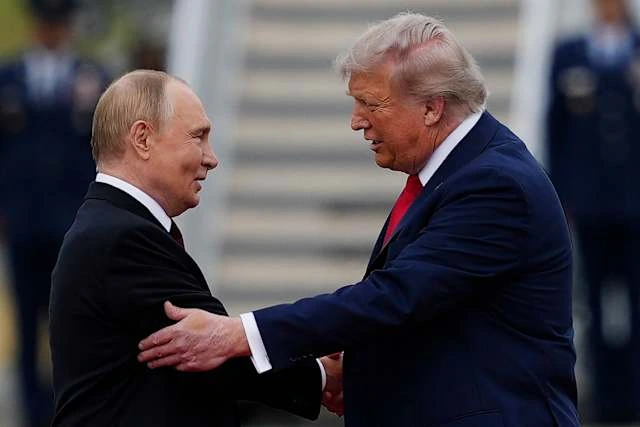
MOSCOW — Russia and the United States have agreed on the need to quickly launch new nuclear arms talks after the expiration of the last remaining treaty limiting their strategic arsenals, the Kremlin said Friday, underscoring rising global concern about an unconstrained nuclear competition between the world’s two largest atomic powers.
The comments followed discussions this week between Russian and US negotiators as the New START treaty formally expired Thursday, ending more than fifty years of legally binding limits on US and Russian nuclear weapons.
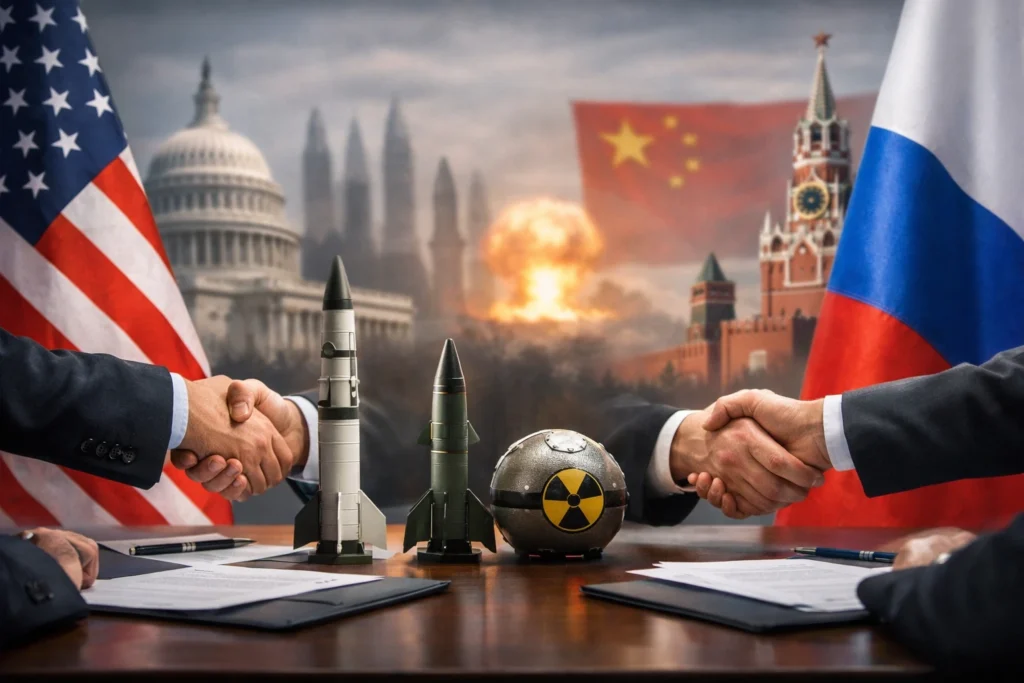
The lapse removes caps on deployed warheads and delivery systems for the first time since the Cold War era, according to data maintained by the Federation of American Scientists.
The end of New START marks a significant moment in global security, eliminating the last verification regime governing US and Russian nuclear forces.
While Moscow has signaled temporary restraint, Washington is pressing for a broader framework that would bring China into future nuclear arms talks, a demand Beijing has so far rejected.
New START, signed in two thousand ten and extended once in two thousand twenty one, limited each side to one thousand five hundred fifty deployed nuclear warheads and seven hundred deployed intercontinental ballistic missiles, submarine launched ballistic missiles and heavy bombers.
The treaty also allowed for on-site inspections and data exchanges that defense officials in both countries long viewed as essential confidence-building tools.Russian President Vladimir Putin said earlier this year that Moscow was prepared to observe New START limits for another year if the United States did the same.
The Biden administration initially signaled openness to talks, but US President Donald Trump has argued that any new agreement must reflect changes in the global nuclear landscape, particularly China’s rapid expansion.
The US State Department said this week that it believes China has conducted covert nuclear explosive tests, allegations Beijing strongly denied.
China’s Foreign Ministry has repeatedly said its nuclear forces are defensive in nature and far smaller than those of Washington or Moscow.Arms control specialists say the urgency around nuclear arms talks reflects both strategic risk and political reality.
“Without New START, both sides lose transparency into each other’s forces, which increases the risk of miscalculation,” said Rose Gottemoeller, former US undersecretary of state for arms control and a chief negotiator of the treaty. She noted that inspections and data exchanges often prevented worst case assumptions during periods of tension.
From Moscow’s perspective, the Kremlin has sought to frame its position as supportive of stability while blaming Washington for the impasse.Dmitry Peskov, spokesman for President Putin, said Friday that Russia remains open to “serious, professional dialogue” on nuclear arms talks, according to state media.
The Trump administration, however, has emphasized China’s role. US Secretary of State Marco Rubio said an agreement that ignores China’s buildup would undermine US and allied security. The Pentagon estimates China could field more than one thousand nuclear warheads by the early twenty thirties, a sharp increase from previous decades.
“China’s arsenal is still smaller, but its growth rate is unprecedented,” said Tong Zhao, senior fellow at the Carnegie Endowment for International Peace. “That is why Washington sees a trilateral framework as increasingly important, even if it is diplomatically difficult.”
European allies have also expressed concern. Josep Borrell, the European Union’s high representative for foreign affairs, said the treaty’s expiration “weakens the global nonproliferation architecture at a time of heightened geopolitical tension.”In Asia, security officials worry about ripple effects.
“The absence of US Russia limits may encourage regional arms buildups,” said Narushige Michishita, professor at Japan’s National Graduate Institute for Policy Studies. “That has implications far beyond Europe.”
Both Washington and Moscow have signaled openness to further engagement, but no timeline for formal nuclear arms talks has been announced.
US officials say any negotiations must account for emerging technologies such as hypersonic weapons and space based systems, while Russia has called for talks to be conducted “without preconditions.”
China has not indicated any shift in its position, maintaining that deeper cuts by the United States and Russia should come first. Diplomats say that reality could complicate efforts to craft a comprehensive framework in the near term.
The expiration of New START leaves a major gap in global arms control, even as Russia and the United States publicly acknowledge the need for renewed nuclear arms talks.
Whether those talks can begin quickly, and whether they can expand to include China, will shape the future of strategic stability at a moment of heightened international uncertainty.


