
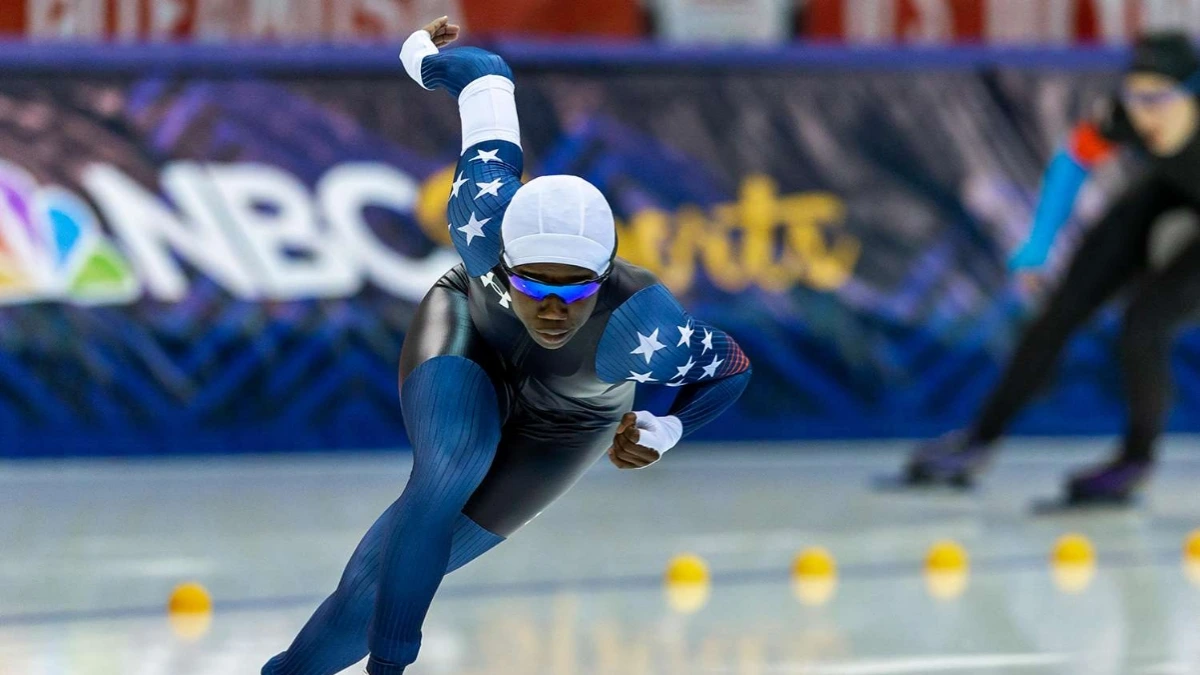
KEY POINT
- Dutch skaters swept gold and silver in the women’s 1,000 meters speed skating final, setting and resetting Olympic records.
- Team USA’s Erin Jackson briefly led the race but finished sixth as final pairings reshaped the standings.
- Brittany Bowe placed fourth, missing a medal in what is expected to be her final Olympic appearance in the event.
WASHINGTON — The women’s 1,000 meters speed skating event at the Milan Cortina Winter Olympics on Monday delivered a tightly contested race that underscored Europe’s dominance in the discipline and the narrow margins separating medalists from the rest of the field.
World record holder Brittany Bowe and Olympic champion Erin Jackson led the early standings for the United States before Dutch skaters surged late, leaving the Americans just outside the podium.
The women’s 1,000 meters speed skating race is widely considered one of the sport’s most technically demanding events, blending explosive speed with sustained power over two laps.
At the Milan Cortina Olympics, the race drew global attention with several reigning champions and record holders on the start list, including two of Team USA’s most accomplished athletes.
Brittany Bowe entered the Milan Cortina Games as the world record holder in the women’s 1,000 meters, a title she secured during the World Cup circuit earlier in the Olympic cycle. Erin Jackson, meanwhile, arrived as the defending Olympic champion in the five hundred meters and one of the most versatile skaters in the US program.
The Netherlands has long been the sport’s standard bearer, supported by a deep national system and extensive investment in long-track speed skating. Dutch skaters have historically dominated Olympic podiums, particularly in middle distance events such as the women’s 1,000 meters speed skating race.
On Monday, Erin Jackson skated in the eleventh pairing and clocked a time of one minute, fifteen seconds flat, briefly moving into the lead ahead of Dutch skater Suzanne Schulting. Jackson’s opening lap placed her among the fastest early contenders, but the final pairings featured skaters capable of redefining the leaderboard.
Dutch skater Jutta Leerdam claimed gold with a time of one minute, twelve point three one seconds, setting a new Olympic record. Teammate Femke Kok earned silver in one minute, twelve point five nine seconds after briefly holding the Olympic record herself. Japan’s Miho Takagi, the reigning Olympic champion in the event, secured bronze in one minute, thirteen point nine five seconds.
Bowe finished fourth in one minute, fourteen point five five seconds, narrowly missing the podium. Jackson placed sixth as later skaters posted faster times.
Ted Morris, high performance director for US Speedskating, said the results reflected the depth of the international field and the challenges of racing from early pairings.
“In the women’s 1,000 meters speed skating race, positioning matters,” Morris said. “Athletes skating earlier often lack the immediate benchmarks that later competitors can chase.”
Kees Verkerk, a former Olympic champion and technical adviser with the International Skating Union, said the Dutch results highlighted system wide advantages.
“The Netherlands has built an environment where multiple skaters can peak simultaneously,” Verkerk said. “That is why you see Olympic records fall in consecutive runs.”
Sports scientist Dr. Laura Peters of the University of Groningen noted that the event increasingly favors skaters who can sustain top-end speed through the final straight. “Data from recent Olympic cycles show that medals are often decided in the last two hundred meters,” Peters said.
Bowe said after the race that execution, rather than preparation, defined the outcome. “The margins were extremely small,” she said. “At this level, a few tenths can change everything.”
Jackson said the experience reinforced the competitiveness of the Olympic field. “You can skate a clean race and still end up off the podium,” she said. “That speaks to how strong the women’s 1,000 meters speed skating field is right now.”
International Skating Union spokesperson Marco Silvestri said the event illustrated the sport’s global growth. “We are seeing record level performances from multiple nations,” Silvestri said. “That is healthy for the future of speed skating.”
US Speedskating officials said the focus now shifts to upcoming events and the development of younger athletes. Bowe has indicated the Milan Cortina Games may mark her final Olympic appearance, while Jackson remains a central figure in the U.S. program across sprint distances.
The women’s 1,000 meters speed skating race at the Milan Cortina Olympics highlighted the sport’s evolving competitive landscape, with Olympic records falling and podium places decided by fractions of a second.
While the United States fell short of a medal, the performances by Erin Jackson and Brittany Bowe underscored the continued presence of American athletes among the world’s elite, even as international depth continues to grow.


