
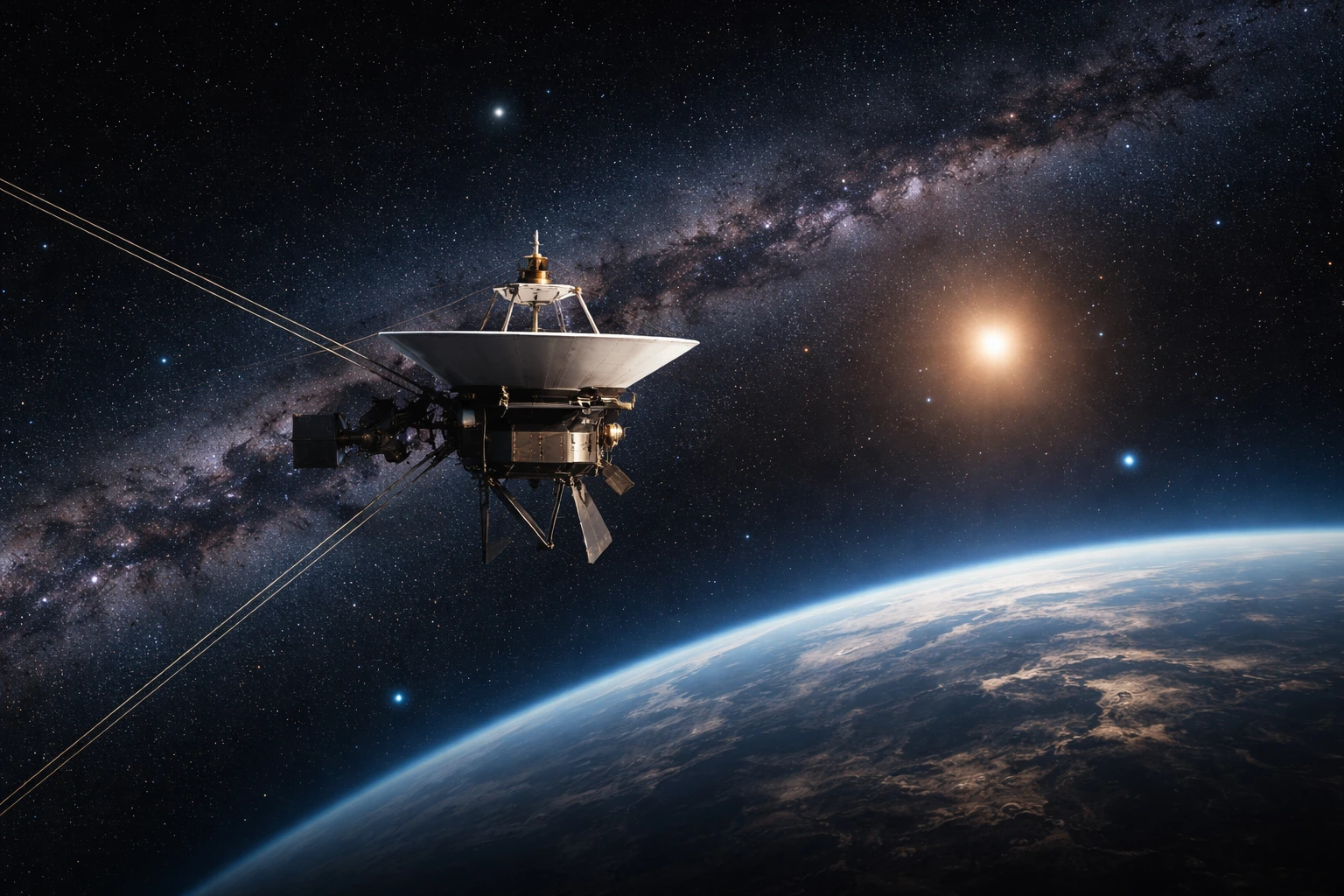
NASA’s Voyager 1 spacecraft is nearing a milestone that underscores both the vastness of space and the endurance of human engineering. By November 2026, Voyager 1 is expected to reach a distance of one light-day from Earth, meaning radio signals traveling at the speed of light will take a full twenty four hours to reach the probe and another twenty four hours for a reply.
The achievement comes almost fifty years after Voyager 1 lifted off from Cape Canaveral, beginning a mission that has transformed scientific understanding of the solar system and beyond.
This milestone really captures the scale of what Voyager has accomplished, said Suzy Dodd, the Voyager project manager at NASA’s Jet Propulsion Laboratory. It reminds us how far this spacecraft has traveled and how carefully we have to operate at these distances.
Voyager 1 launched in September 1977, part of a twin mission with Voyager 2 designed to take advantage of a rare planetary alignment. Jupiter, Saturn, Uranus and Neptune were positioned in a way that allowed spacecraft to use gravitational assists, often described as slingshot maneuvers, to gain speed and visit multiple planets.
Now traveling nearly sixteen billion miles from Earth, Voyager 1 remains the farthest human-made object in space.
Related Article:
Experts say the approaching one light-day distance highlights not only scientific ambition but also the limits of real-time control.
At this range, spacecraft operations are more like sending messages in bottles than piloting a vehicle, said Dr. Marcus Hill, a space historian at the University of Colorado. You plan carefully, you wait, and you hope the systems onboard respond exactly as designed.
Dodd explained that Voyager 1 transmits data at about 160 bits per second, comparable to early dial-up internet connections. Weak signals require multiple antenna arrays on Earth to capture even small amounts of information.
That delay changes how you think about problem-solving, she said. “lThere are no quick fixes.
To put the Voyager 1 one light-day milestone into perspective, light travels about 186,000 miles per second. Even at that speed, crossing the distance between Earth and Voyager 1 will soon take a full day.
By comparison, signals to Mars take between four and twenty four minutes depending on planetary positions. Communications with Voyager 1 will soon require nearly one hundred times more patience.
The spacecraft’s power source, a radioisotope thermoelectric generator, is steadily weakening. Engineers have already shut down several instruments to conserve energy, allowing the remaining systems to operate into the late 2020s.
For many who worked on the mission, the milestone carries emotional weight.
I joined the project long after launch, but it feels like caring for a living thing,said Elena Ramirez, a systems engineer at JPL. Knowing it’s about to be one light-day away is both thrilling and humbling.
Outside the scientific community, Voyager 1 continues to inspire the public.
When I teach my students about Voyager, they can’t believe something built in the seventies is still working, said high school physics teacher Daniel Brooks in Pasadena. It makes space feel real, not abstract.
As Voyager 1 moves farther into interstellar space, communication will grow more difficult and data even more limited. The spacecraft is designed to protect itself, automatically entering a safe state if it detects serious problems.
If something goes wrong, Voyager can wait for us, Dodd said. That autonomy is one reason it has survived this long.
NASA expects Voyager 1 to continue sending basic engineering data for several more years, offering rare measurements of the space between stars.
The Voyager 1 one light-day milestone stands as a marker of human curiosity and persistence rather than a dramatic endpoint. Nearly fifty years after launch, the spacecraft continues to send faint signals home, stretching communication across an almost unimaginable distance. As Voyager 1 moves deeper into interstellar space, it remains a quiet reminder of how far exploration can go, even with technology built for another era.


