
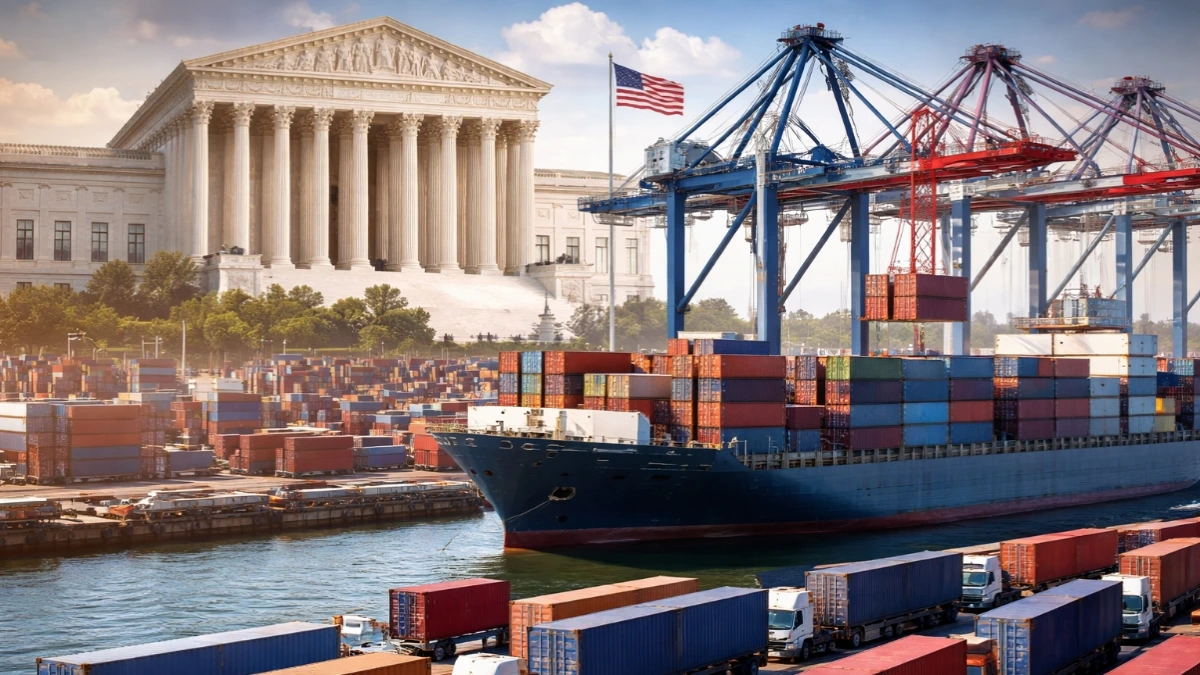
WASHINGTON A pending U.S. Supreme Court decision on the legality of tariffs imposed under former President Donald Trump’s administration has freight and logistics companies closely watching, as the ruling could influence not only potential refunds but also the volume of goods imported into the United States, experts say.
The case centers on tariffs levied under the International Emergency Economic Powers Act, a measure that critics argue was implemented without proper congressional authority. The decision comes at a crucial time, with the Chinese New Year approaching and U.S. importers preparing for peak shipping season.
The tariffs, introduced during the Trump administration, targeted hundreds of billions of dollars in Chinese goods.
Companies responded by frontloading imports in 2025 to soften financial impacts, creating an unusual pattern in freight movement and leading to a temporary rate recession.
“If the Supreme Court rules these tariffs were applied illegally, we could see a significant rebound in imports,” said Paul Brashier, vice president of global supply chain for ITS Logistics.
Businesses would likely feel more confident in their cash positions and take the opportunity to rebuild inventories ahead of any new trade restrictions.
Legal experts note that the court’s decision could have broad ramifications beyond the immediate financial refunds.
A ruling against the tariffs would reset trade expectations for hundreds of importers, said Karen Liu, trade law professor at Georgetown University. It would signal that future tariff plans must be more carefully structured, which could impact supply chain planning nationwide.
Industry analysts predict that the decision could create short-term volatility in freight volumes. Companies may accelerate shipments to capitalize on lower tariff exposure, potentially straining port capacity and logistics networks.
Freight rates and container movements are sensitive to these legal decisions, said Rafael Ortega, chief analyst at Global Trade Advisors.
Even a temporary boost in imports could ripple across trucking, rail, and port operations. The uncertainty alone can slow planning.
The International Emergency Economic Powers Act tariffs have been a point of contention in multiple legal filings, with importers seeking reimbursement for duties paid. Some argue that the financial stakes are significant enough to influence global trade patterns.
U.S. container imports fell sharply in mid-2025 as companies frontloaded shipments earlier in the year.
According to data from the American Association of Port Authorities, container volumes at major U.S. ports declined by nearly seven percent compared with the same period in 2024, reflecting an uneven peak season.
Historical data suggest that lifting or reducing tariffs could increase imports by five to ten percent in the following quarter.
Analysts note that the effect would be especially pronounced for consumer electronics, industrial machinery, and automotive parts, sectors that are highly sensitive to trade costs.
Importers and small logistics firms are closely monitoring the case. We’re holding off on major shipments until we know the court’s position, said Michelle Tran, operations manager at Pacific Freight Solutions in Los Angeles. Even a small change in tariff law could change our buying strategy and cash flow.
At the Port of New York and New Jersey, terminal operators report mixed expectations. There’s a cautious optimism, said Jorge Ramirez, a senior logistics coordinator. Shippers are considering whether to stockpile products, but they also need clarity to avoid overcommitting.
If the Supreme Court rules against the tariffs, economists predict a short-term increase in U.S. imports and shipping volumes, potentially easing costs for some businesses while creating temporary congestion at ports.
Conversely, a decision upholding the tariffs would maintain current trade patterns, with importers continuing cautious inventory strategies.
The ruling will not only affect refunds but also the flow of goods, port activity, and supply chain timing, said Liu. It’s a pivotal moment for U.S.-China trade relations and the logistics sector.
As the Supreme Court prepares to issue its decision, companies, analysts, and port operators await guidance that could influence U.S. import volumes ahead of the Chinese New Year.
While the immediate focus is on potential tariff refunds, the broader implications for trade flows, container movement, and supply chain planning highlight the interconnected nature of legal and economic policy decisions.


