
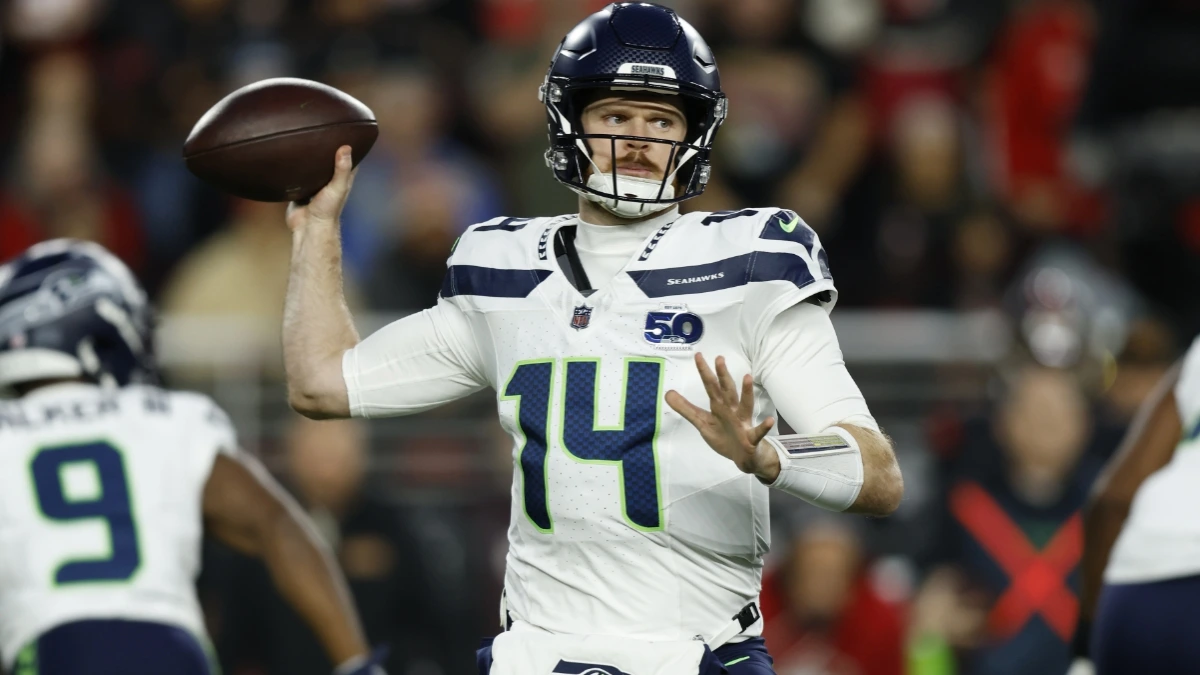
The Seattle Seahawks added quarterback Sam Darnold to the injury report on Friday, listing him as questionable for Saturday night’s divisional round playoff game against the San Francisco 49ers because of an oblique injury, a late development that introduces uncertainty at the most critical position ahead of a high-stakes NFC matchup.
Key Takeaways
- The Sam Darnold injury report lists the Seahawks quarterback as questionable with an oblique injury ahead of the divisional round game vs. the 49ers.
- Darnold participated in practice and was observed jogging without visible limitation, according to team media access.
- The designation places increased focus on Seattle’s contingency plans at quarterback against a division rival with postseason familiarity.
The timing of the update made the listing notable. Darnold had not appeared on the Seahawks’ injury report earlier in the week, and the oblique issue was disclosed for the first time less than twenty-four hours before kickoff.
In the postseason, where preparation windows are narrow and margins are thin, even a minor limitation can alter game planning and roster decisions.
Darnold has served as Seattle’s primary quarterback through the latter portion of the season, stabilizing an offense that emphasized ball security and controlled tempo.
The Seahawks enter the divisional round facing a 49ers team they know well, having met twice during the regular season and annually in high-leverage NFC West games.
Oblique injuries can vary widely in severity. They often affect rotational movement and throwing mechanics, particularly for quarterbacks who rely on core strength for velocity and accuracy.
Teams typically monitor such injuries closely because discomfort can increase during warmups or after repeated throws.
Seattle did not specify when the injury occurred. Darnold was present at practice Friday and was seen jogging on the field without apparent restriction during the portion open to media. The Seahawks declined to provide further medical detail, consistent with league policy.
The Sam Darnold injury report arrives as the Seahawks finalize their playoff roster and emergency depth chart. Under NFL postseason rules, teams must be prepared for in-game contingencies without the benefit of an expanded active roster.
Medical analysts who study football-related core injuries note that oblique strains can be difficult to assess externally.
Dr. Michael Sato, a sports medicine physician unaffiliated with the Seahawks, said oblique issues “may not limit straight-line movement but can affect explosive rotation,” which is central to quarterback throwing motion.
From a strategic standpoint, the designation does not automatically signal that Darnold will miss the game.
In the postseason, teams often list players as questionable to preserve flexibility. Still, it forces opponents to prepare for multiple scenarios.
Seattle’s offensive approach against San Francisco has historically emphasized timing routes, play-action and movement within the pocket.
Any limitation in core strength could influence the frequency of deep throws or rollouts. Coaches may adjust protections or play selection accordingly if the quarterback is less than full strength.
Seahawks coach Pete Carroll said the team would “monitor everything closely” through pregame warmups and emphasized that postseason injury designations are handled with caution, according to team transcripts.
An NFC assistant coach from another team, speaking on background due to league policy, said late-week quarterback listings often reflect “maintenance as much as risk,” especially when the player has taken the majority of game-plan reps.
A Seahawks team source familiar with practice observations said Darnold “did not appear limited in movement,” though the source acknowledged that throwing volume and intensity are typically managed late in the week regardless of injury status.
The Seahawks are expected to make a final determination on Darnold’s availability closer to kickoff, after medical evaluation and pregame throwing sessions. If he is cleared but limited, Seattle could emphasize quicker reads and a balanced run-pass approach to reduce strain.
If the quarterback were unable to start or finish the game, the Seahawks would turn to their backup, who has taken reduced but consistent practice reps during the week.
League rules require teams to designate an emergency quarterback plan for postseason games, underscoring the importance of preparation.
Beyond Saturday, the Sam Darnold injury report will remain relevant only if Seattle advances. Oblique injuries often respond to rest and treatment, but repeated use can aggravate symptoms, making weekly management a factor during a deep playoff run.
The late addition of Sam Darnold to the injury report introduces a layer of uncertainty for the Seahawks ahead of a pivotal divisional round matchup against the 49ers.
While initial observations suggest mobility is not significantly affected, the questionable designation highlights the importance of quarterback health in postseason football and places added attention on Seattle’s readiness at the game’s most influential position.


