
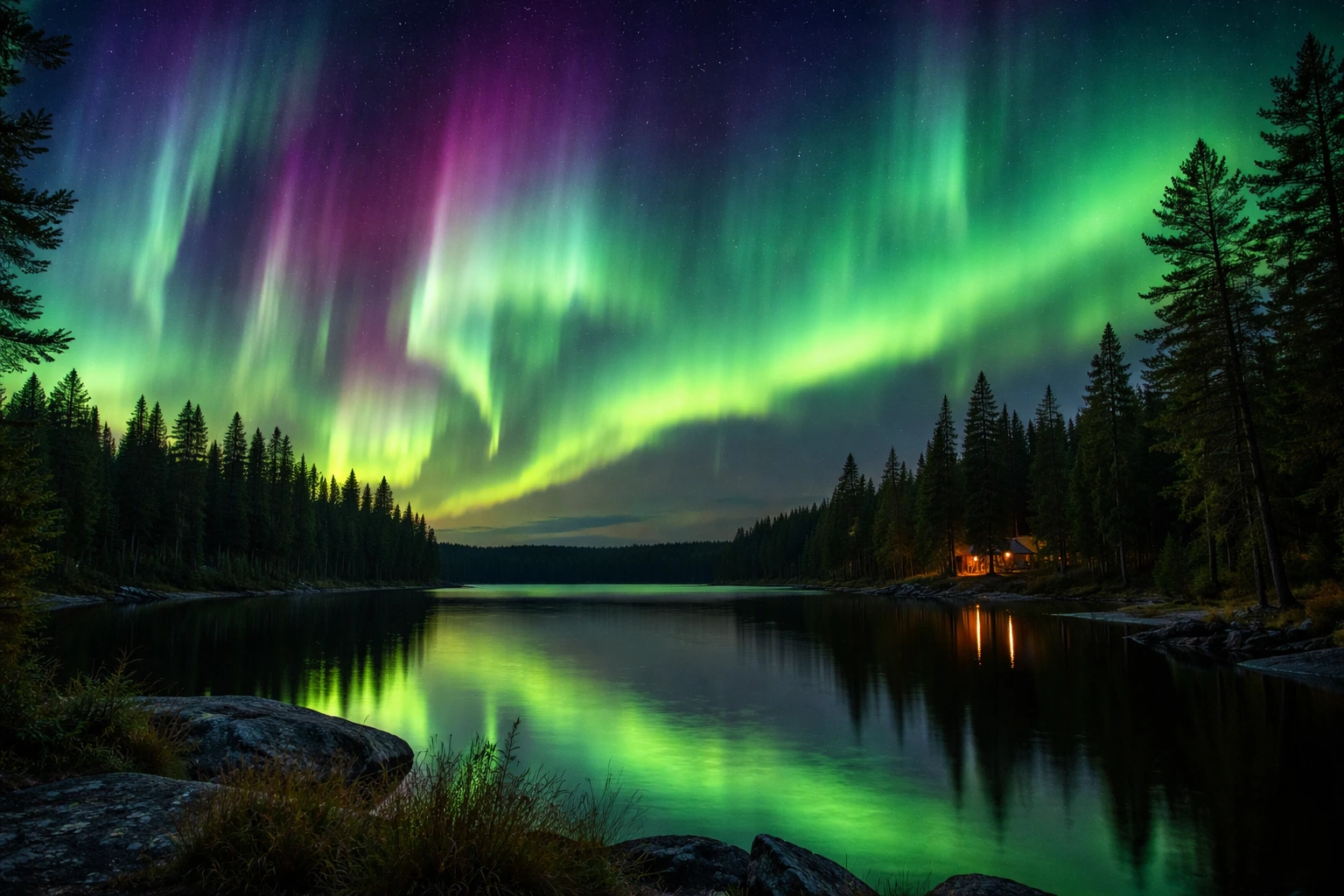
WAUSAU, Wis. A strong solar eruption is expected to produce a rare geomagnetic storm that could make the Northern lights visible across parts of Wisconsin from Monday night into early Tuesday, according to forecasters.
The National Oceanic and Atmospheric Administration (NOAA) Space Weather Prediction Center has issued a G4 geomagnetic storm watch, signaling potentially intense aurora activity that could reach farther south than usual.
KEY POINT
- NOAA has placed a G4 geomagnetic storm watch in effect as a coronal mass ejection (CME) approaches Earth.
- If conditions align, the aurora could be visible well beyond typical northern latitudes, potentially across Wisconsin and other mid-latitude states.
- Strong geomagnetic storms can affect power grids, satellite operations, and radio communications, in addition to creating auroral displays.
The incoming CME is a significant burst of solar material and magnetic energy traveling from the Sun toward Earth. When these particles interact with Earth’s magnetic field, they can produce the colorful glows and dynamic curtains of light known as the aurora borealis.
While auroras are normally limited to far northern regions, a severe G4 storm can expand the visible range into areas that rarely experience them.
Coronal mass ejections occur when the Sun releases large quantities of plasma and magnetic fields into space. Unlike solar flares, which produce near-instantaneous radiation, CMEs take one to several days to reach Earth.
The severity of the resulting geomagnetic storm depends on the alignment of the CME’s magnetic field with Earth’s magnetosphere. A southward orientation tends to amplify geomagnetic effects, increasing the likelihood of auroras at mid-latitudes.
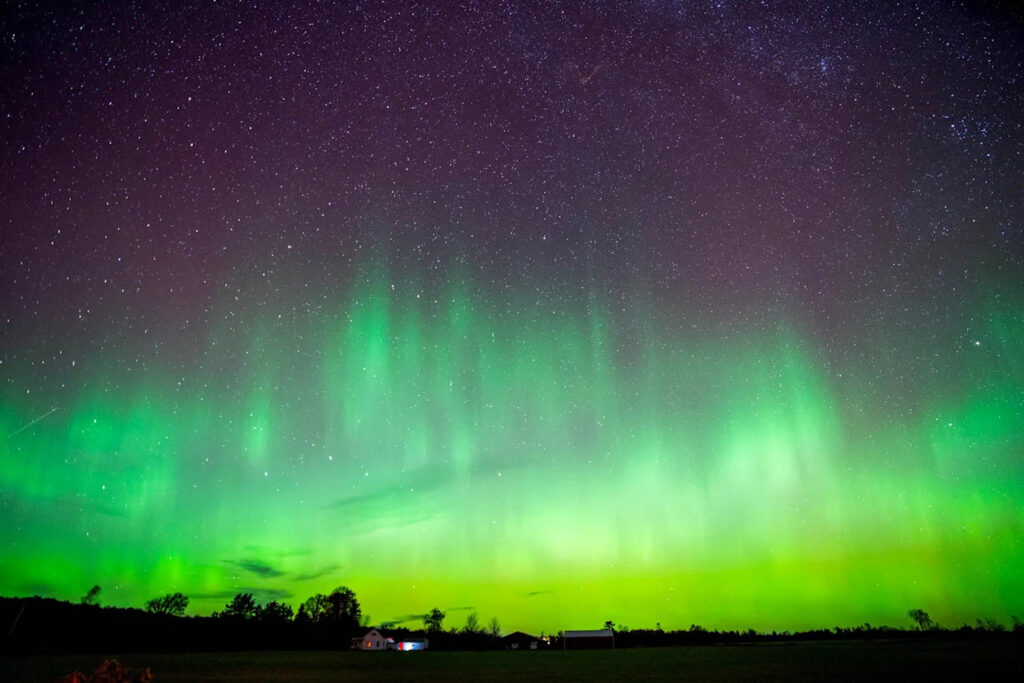
Historical observations show that strong geomagnetic storms can produce auroras hundreds of miles further south than usual.
In November 2025, a particularly intense storm allowed observers to see the Northern lights as far south as New Mexico and Texas, illustrating how powerful solar activity can extend auroral visibility.
Dr. Eleanor Finch, a space physicist at the University of Alaska Fairbanks, noted that G4 geomagnetic storms are uncommon and represent conditions under which the auroral oval expands dramatically.
“For observers in Wisconsin, this could result in anything from subtle glows along the northern horizon to full-scale ribbons of light across the sky,” she said.
Finch emphasized that local weather and sky clarity will determine actual visibility.
NOAA warns that G4 storms are not only visually impressive but can also have tangible effects on modern technology.
Voltage fluctuations in power grids, disruptions to satellite navigation systems, and interference with high-frequency radio signals are all possible during such events. Utilities and satellite operators closely monitor these warnings to mitigate potential disruptions.
Robert Chan, an amateur astronomer from Madison, Wisconsin, said he plans to travel outside city limits for a clear view. “Even a faint green glow is worth staying up for — it’s one of nature’s most beautiful phenomena,” he said.
Meteorologist Lindsey Slater said clear skies and cold winter air could improve visibility. “The Arctic air coming in could create optimal conditions for seeing auroras, provided clouds stay away,” she said.
The Sun remains in an active phase of its 11-year cycle, which means more geomagnetic storms and aurora events are possible through 2026.
Forecasters will continue monitoring incoming CMEs and high-speed solar wind streams. Real-time alerts and aurora forecasts from NOAA provide guidance for both skywatchers and industries sensitive to space weather.
The G4 geomagnetic storm watch signals a rare opportunity for residents of Wisconsin to witness the Northern lights.
Should the CME interact strongly with Earth’s magnetic field, the event could offer a display seldom seen at mid-latitudes, highlighting the far-reaching effects of solar activity on Earth’s near-space environment


