
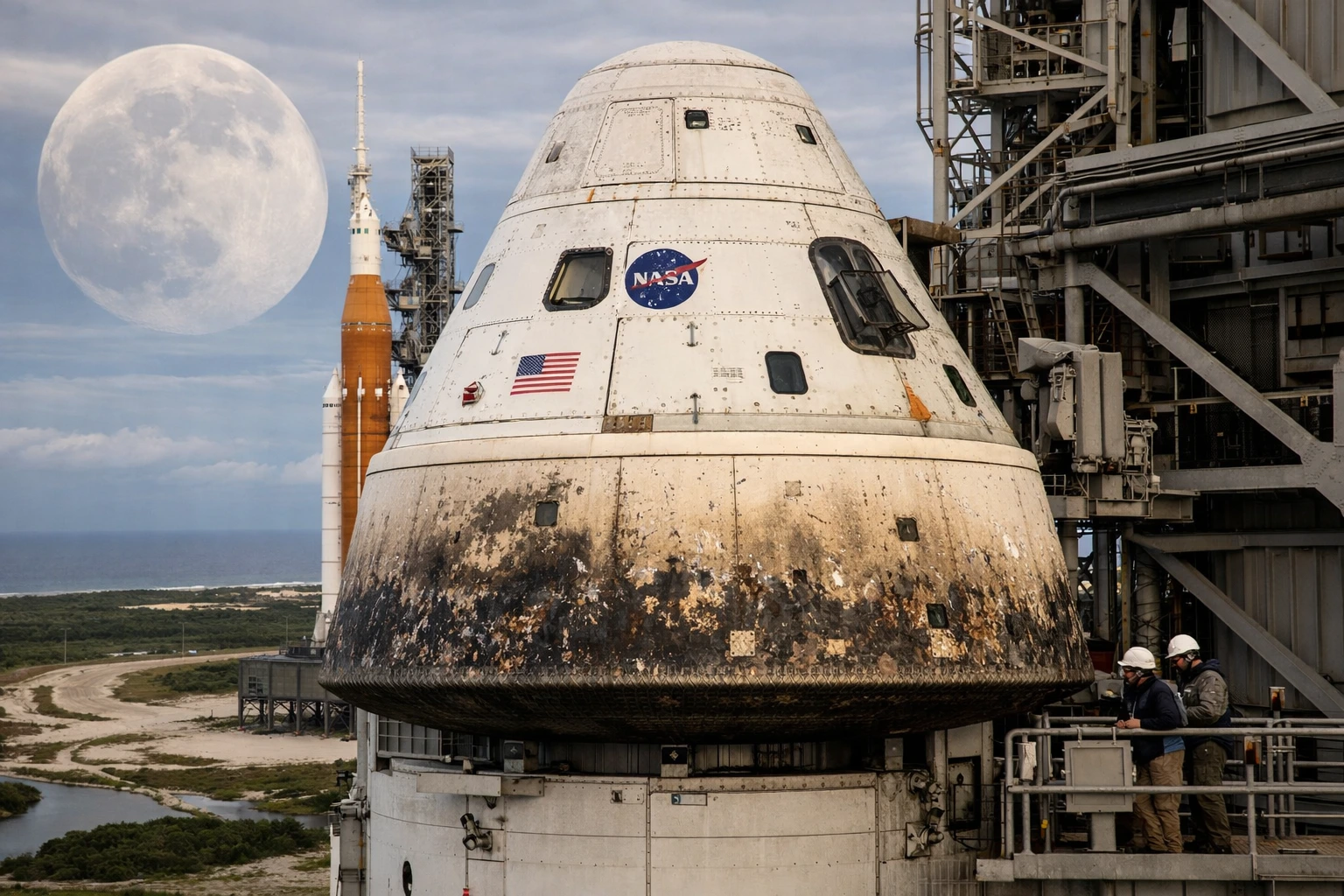
CAPE CANAVERAL, Fla. NASA plans to send four astronauts on a historic journey around the moon as soon as Feb. 6 aboard the Orion spacecraft, moving forward with the Artemis II mission despite unresolved questions surrounding the Orion heat shield issue that emerged during a prior uncrewed test flight. The agency says it has sufficient understanding of the problem to safely fly astronauts, even as some independent experts urge caution.
KEY POINT
- NASA will launch Artemis II with astronauts despite the unresolved Orion heat shield issue identified after Artemis I.
- The heat shield damage did not compromise crew safety in testing, according to NASA engineers.
- The decision carries implications for schedule, cost and confidence in the broader Artemis lunar program.
The Artemis II mission represents NASA’s first crewed voyage beyond low Earth orbit since Apollo 17 in 1972.
The four astronauts will not land on the moon but will travel thousands of miles beyond it, testing spacecraft systems critical to future lunar landings.
Central to that effort is the Orion heat shield, a protective barrier designed to absorb and shed extreme heat as the spacecraft reenters Earth’s atmosphere at speeds exceeding twenty-five thousand miles per hour.
NASA officials say the agency is prepared to proceed, even though the Orion heat shield issue identified after Artemis I has not been fully eliminated.
The decision underscores the balance NASA faces between advancing human exploration and managing engineering risk in a program already marked by delays and cost overruns.
Artemis I launched in November 2022 as an uncrewed test of the Space Launch System rocket and Orion capsule.
When Orion returned to Earth after a twenty-five-day mission, engineers discovered unexpected charring and erosion across portions of the heat shield.
The shield, made of an ablative material known as Avcoat, is designed to burn away in a controlled manner, carrying heat away from the spacecraft.
According to NASA, the Artemis I heat shield experienced uneven material loss due to gas flow dynamics that were not fully predicted in preflight modeling.
While the spacecraft safely splashed down in the Pacific Ocean, the visual damage raised questions about whether similar behavior could pose risks during a crewed return.
The Orion heat shield issue prompted months of analysis, ground testing and computer simulations.
NASA ultimately chose not to redesign the shield for Artemis II, citing schedule constraints and confidence that the observed behavior fell within acceptable safety margins.
NASA’s decision reflects a broader philosophy shaped by decades of human spaceflight, where absolute elimination of risk is impossible.
Agency leaders emphasize that the Orion heat shield issue does not represent a failure of the system but a gap in predictive modeling.
“This is not a loss of capability,” said Jim Free, NASA associate administrator for exploration systems development, according to agency briefings.
“The heat shield performed its job. Our work has been to understand why it looked the way it did when it came home.”
Some former NASA engineers and independent aerospace safety specialists remain unconvinced.
They argue that flying astronauts before fully resolving the modeling discrepancy introduces uncertainty into the most dangerous phase of the mission.
The debate highlights a recurring tension in US space policy: whether to accept known technical unknowns in order to maintain momentum and political support for exploration programs funded by Congress.
| Mission | Year | Crewed | Heat Shield Outcome | Program Cost to Date |
|---|---|---|---|---|
| Apollo 8 | 1968 | Yes | Nominal performance | Adjusted $20 billion |
| Orion EFT-1 | 2014 | No | Nominal performance | Included in Orion dev |
| Artemis I | 2022 | No | Unexpected erosion | Over $4 billion |
| Artemis II | 2026 | Yes | Pending | Over $4 billion |
NASA Administrator Bill Nelson has defended the agency’s approach, saying the decision to fly Artemis II reflects confidence built on extensive testing and review.
“We would not put astronauts on board if we did not believe this vehicle could bring them home safely,” Nelson said during a recent briefing.
Christina Koch, one of the Artemis II astronauts, acknowledged the scrutiny surrounding the mission.
“We are aware of the discussions,” she said in a NASA interview. “Our job is to trust the process and the people who have worked this problem from every angle.”
Outside the agency, former NASA safety panel member Scott Hubbard said the issue illustrates the importance of transparency.
“NASA has to explain not just that it is safe, but why it is safe, in terms the public can understand,” he said.
NASA plans to gather extensive data during Artemis II, including detailed thermal and structural measurements during reentry.
That information will inform potential refinements to the heat shield ahead of Artemis III, which is intended to land astronauts on the lunar surface later in the decade.
Any significant anomaly during Artemis II could ripple across the Artemis schedule, affecting international partners and commercial contractors involved in lunar lander and gateway development.
The decision to proceed with Artemis II despite the Orion heat shield issue marks a pivotal moment for NASA’s return to the moon effort.
How the spacecraft performs during its fiery return to Earth will shape not only the future of Orion but also the credibility of the Artemis program as it moves toward sustained human presence beyond Earth orbit.


