
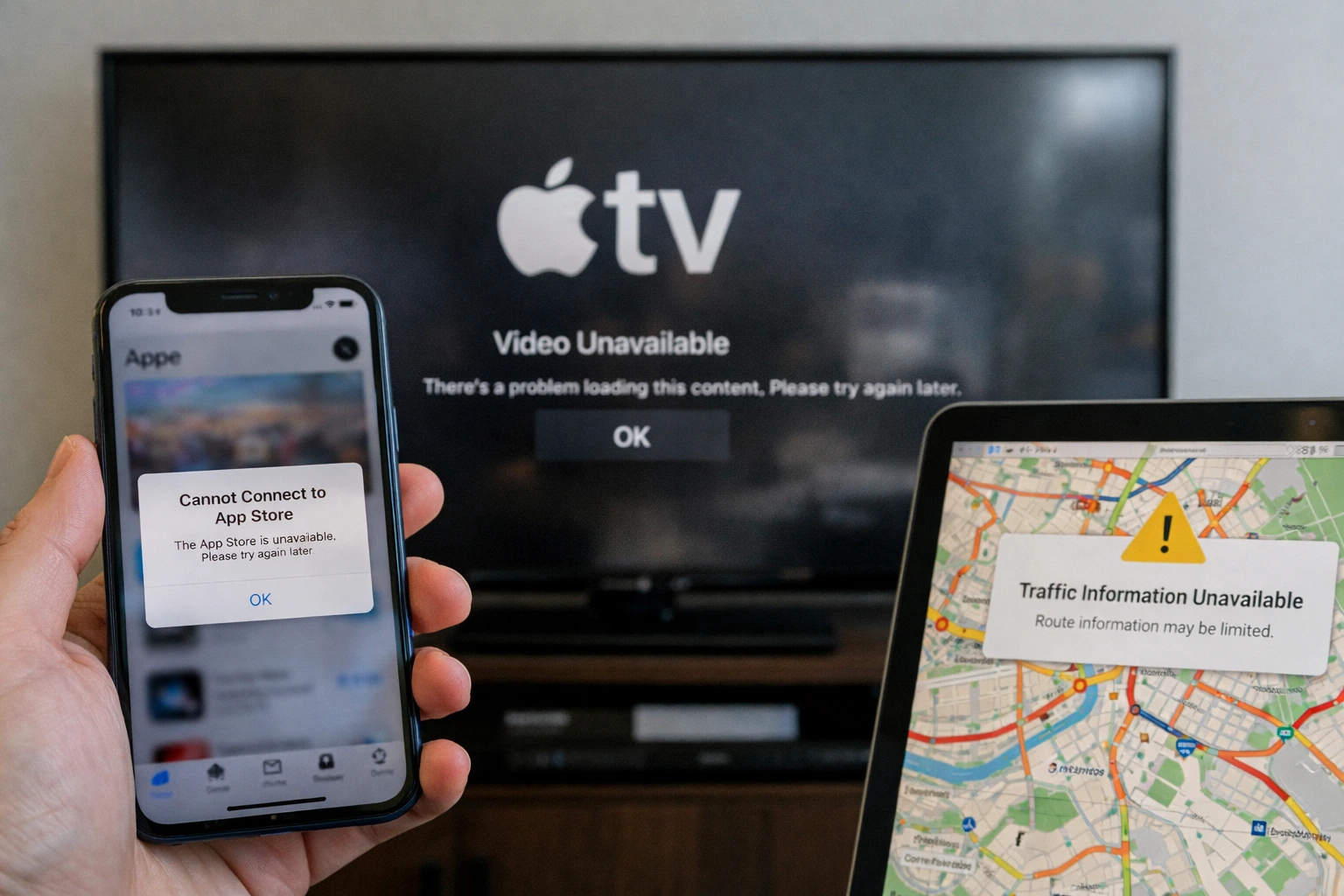
An Apple services outage disrupted access to the App Store, Apple TV and Apple Maps for users and developers worldwide on Tuesday evening, temporarily interrupting app downloads, media streaming, navigation features and cloud-based collaboration tools, according to Apple’s system status data.
KEY POINT
- The Apple services outage affected core consumer and developer platforms for about four hours.
- App distribution, media purchases and live traffic data were among the most impacted functions.
- The disruption highlighted the global reliance on Apple’s centralized cloud infrastructure.
The Apple services outage underscored how deeply integrated Apple’s online services are into everyday digital activity, from entertainment and navigation to business operations and education.
While Apple said the issues were resolved within hours, the incident affected millions of users across multiple regions and raised questions about resilience as Apple continues to expand its services-driven business model.
According to Apple’s System Status page, the outage began around 6:48 p.m. Eastern Time and was largely resolved by about 10:30 p.m. Eastern Time. Services impacted included the App Store, Apple TV, Apple TV Channels, the iTunes Store and Maps Traffic.
Additional services were identified as affected later in the evening, including Apple Maps routing and navigation and Apple Photos, which supports cloud-based image syncing.
Apple also flagged issues with iWork for iCloud, potentially affecting document collaboration and real-time syncing for users of Pages, Numbers and Keynote.
Other services marked with disruptions included iMessage, iCloud Mail, Apple News, Apple School Manager, Apple Business Manager and Apple Business Essentials, though Apple noted that only some users experienced access problems.
Apple services outages are relatively infrequent but can have wide-reaching effects due to the company’s tightly integrated ecosystem. Nearly all Apple devices rely on centralized servers for authentication, content delivery and cloud synchronization.

When those systems slow or fail, the impact extends beyond consumer inconvenience to businesses, schools and developers who depend on Apple’s platforms for daily operations.
Industry analysts said the Apple services outage illustrates the scale risk that accompanies platform consolidation. Apple has increasingly positioned services such as streaming, cloud storage and payments as a major growth engine, reporting tens of billions of dollars in annual services revenue.
“Apple’s ecosystem delivers convenience through integration, but that same integration means outages cascade quickly across multiple products,” said Patrick Moorhead, an independent technology analyst at Moor Insights & Strategy.
“When the App Store goes down, it is not just a storefront problem. It affects developers’ revenue, security updates and user trust.”
Developers were particularly affected because App Store disruptions can delay app updates and security patches.
In the European Union, where Apple now supports third-party app marketplaces under new competition rules, App Store authentication and distribution services still play a central technical role.
Navigation disruptions added a real-world dimension to the outage. Maps Traffic data powers congestion indicators, estimated arrival times and features such as speed trap alerts in supported regions.
Any degradation in that data can affect commuters and logistics operations, especially during peak evening hours.
Apple did not provide a detailed technical explanation for the outage, stating only on its status page that services were “experiencing issues” before later marking them as resolved.
“For developers, even a short outage can have outsized consequences,” said Sarah Perez, a mobile app industry researcher.
“Missed update windows can delay bug fixes or compliance changes, which matters in regulated markets.”
Users reported mixed experiences, with some unable to download apps or stream content, while others experienced slower performance rather than complete outages.
“My apps just kept spinning and never downloaded,” said Daniel Wu, an Apple TV user in Singapore. “Streaming finally worked again later in the evening.”
Apple has invested heavily in redundancy and global data centers to support its expanding services portfolio.
While brief outages are unlikely to alter user behavior in the long term, analysts said transparency and rapid communication remain critical as Apple’s services footprint grows.
Regulators and enterprise customers are also paying closer attention to platform reliability, particularly as Apple positions its services for education, healthcare and business use. Continued expansion may bring increased scrutiny of uptime guarantees and incident reporting standards.
The Apple services outage was resolved within hours, but it highlighted the broad economic and practical impact of disruptions in a highly centralized digital ecosystem.
As Apple continues to deepen its reliance on services revenue, the stability of platforms such as the App Store, Apple TV and Apple Maps will remain central to user trust and global digital infrastructure.


