
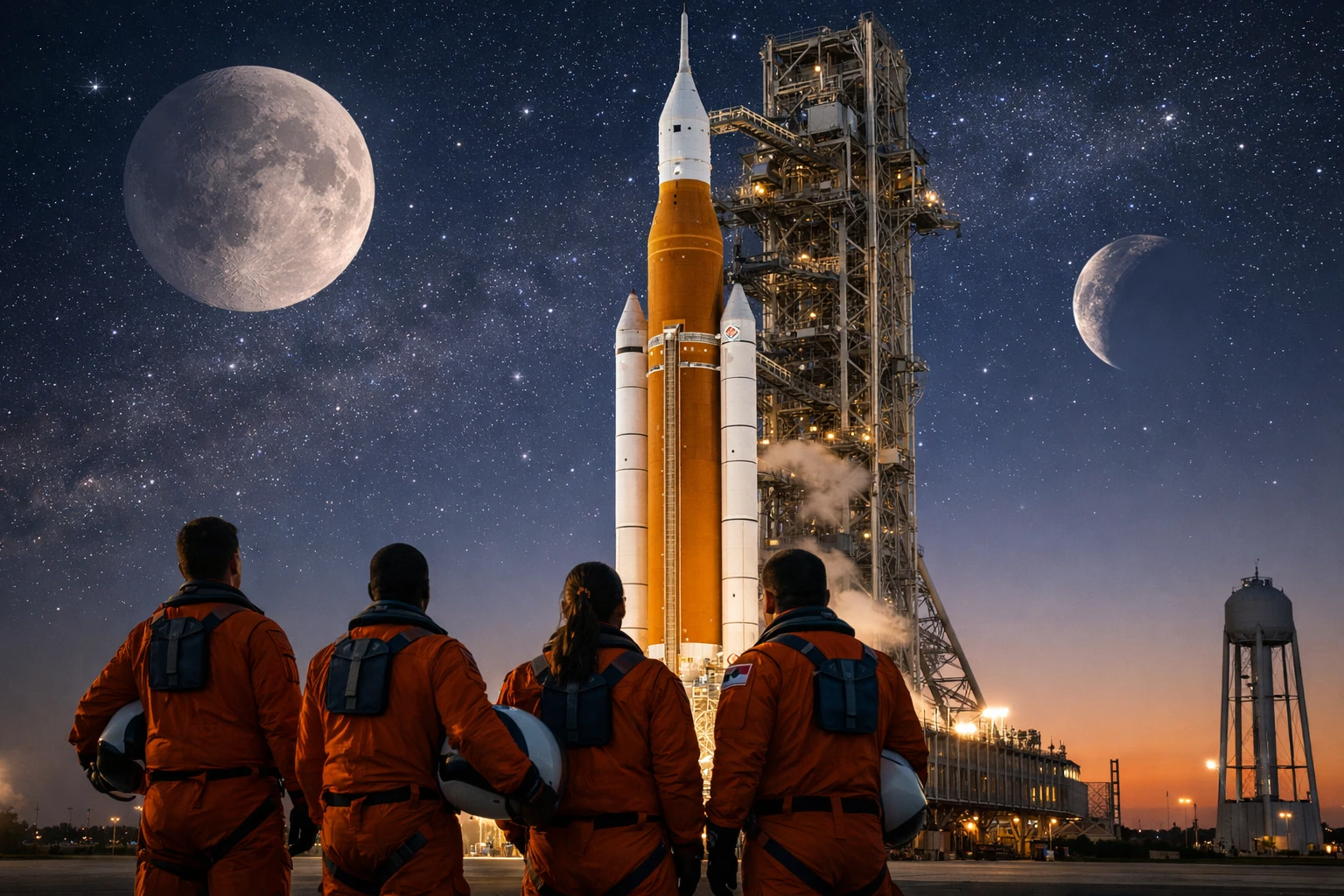
Four astronauts are preparing to travel farther from Earth than any humans in more than five decades, but they will not land on the moon. The Artemis II mission, scheduled to launch as soon as February six from Kennedy Space Center in Florida, will send a NASA crew aboard the Space Launch System rocket and Orion capsule on a ten-day journey around the moon, marking a critical test flight in the agency’s plan to return humans to the lunar surface.
KEY POINTS
- The Artemis II mission will carry four astronauts beyond the far side of the moon without attempting a landing.
- NASA is prioritizing crew safety and system validation before introducing a lunar lander.
- The flight represents a major milestone in rebuilding human deep-space capability after Apollo.
The Artemis II mission represents NASA’s first crewed lunar voyage since Apollo seventeen in nineteen seventy two. While public attention often focuses on moon landings, this mission is designed for a different purpose:
proving that NASA can safely send humans beyond low Earth orbit and bring them home. The mission’s significance lies not in where the astronauts will walk, but in what systems they will validate for future exploration.
NASA’s Artemis program was created to reestablish human presence at the moon as a stepping stone for future missions to Mars.
Artemis I, flown in twenty twenty two, sent an uncrewed Orion spacecraft around the moon to test propulsion, navigation, heat shielding and communications. Artemis II builds directly on that flight by adding astronauts to the same core systems.
The Space Launch System rocket, standing more than three hundred twenty feet tall, will lift the Orion capsule into space. Orion will then carry the crew on a lunar flyby trajectory, looping behind the moon and returning to Earth.
This path allows engineers to test deep-space navigation, life-support systems and reentry at lunar-return speeds without the added complexity of landing hardware.
The last time humans traveled this far from Earth was during the Apollo thirteen mission, which reached a distance of about two hundred forty eight thousand miles during a crisis-driven flyby. Artemis II is expected to exceed that distance under controlled conditions.
NASA officials emphasize that the absence of a landing is a deliberate risk-management decision. Patty Casas Horn, deputy lead for mission analysis and integrated assessments at NASA, said the agency follows a step-by-step development philosophy.
This is not a lunar lander, Horn said. We build out a capability, then we test it out. Artemis II is really about the crew.
Landing on the moon requires a separate spacecraft capable of descending to and ascending from the lunar surface.
Under the Artemis architecture, that role will be filled by a commercially developed human landing system, which will not be introduced until later missions.
By separating transportation from landing, NASA aims to reduce technical risk and allow multiple systems to mature independently.
The mission also carries broader implications for international cooperation. The inclusion of Canadian Space Agency astronaut Jeremy Hansen reflects a growing multinational framework that NASA sees as essential for sustaining long-term lunar exploration.
NASA Administrator Bill Nelson said Artemis II is focused on rebuilding skills lost after Apollo.
“We are learning again how to operate humans in deep space, Nelson said. That experience is essential before putting astronauts on the lunar surface.
Reid Wiseman, the mission commander, said the crew understands the importance of the flight’s objectives.
Our job is to test the spacecraft and the systems that will carry future crews, Wiseman said. “Every piece of data we collect helps the next mission.
Christina Koch said the mission also carries symbolic weight.
This flight represents progress toward sustainable exploration,” Koch said. “It shows that we are committed to doing this the right way.
If the Artemis II mission meets its objectives, NASA plans to proceed with Artemis III, which would attempt the first crewed lunar landing of the Artemis era.
That mission will depend on the readiness of the lunar lander, spacesuits and supporting infrastructure such as the Gateway lunar outpost.
NASA officials stress that schedules remain flexible and dependent on testing outcomes. Each Artemis mission is intended to build incrementally toward a sustained human presence on and around the moon.
The Artemis II mission will not place astronauts on the moon, but it marks a decisive step toward that goal.
By focusing on crewed deep-space operations rather than a landing, NASA is prioritizing safety, reliability and long-term capability.
The mission’s success would signal that humanity is once again prepared to venture beyond Earth orbit, laying the groundwork for future exploration of the moon and beyond.


