
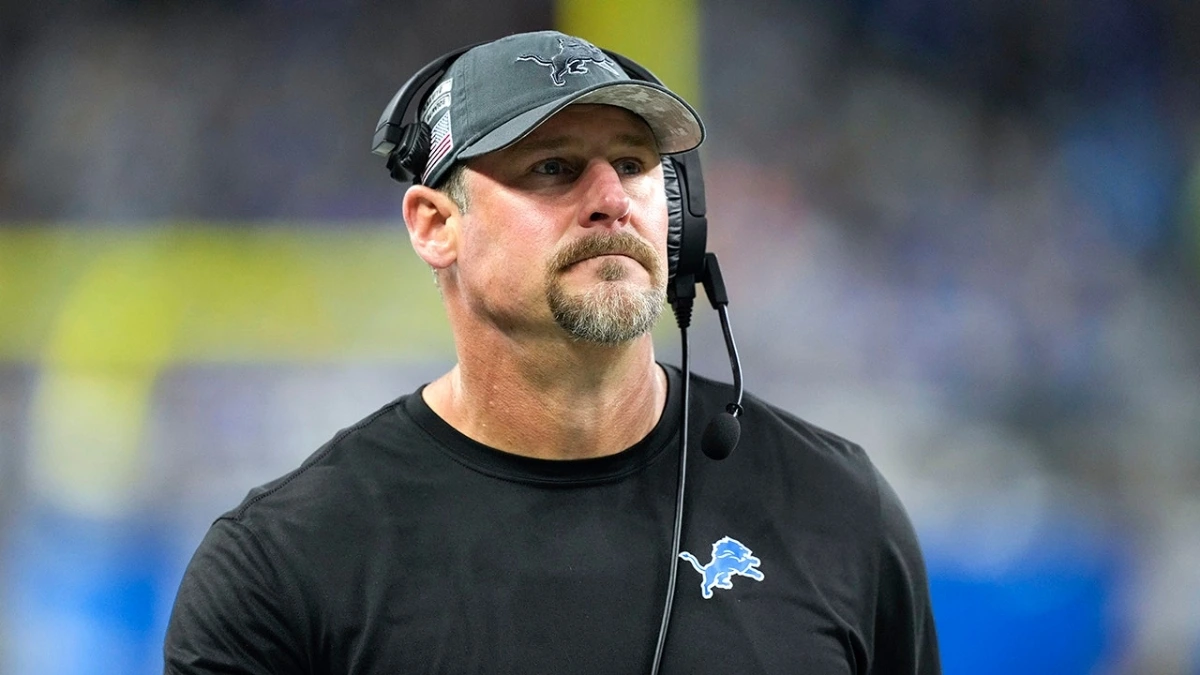
The Detroit Lions are hiring Drew Petzing as their new offensive coordinator, adding an experienced playcaller to coach Dan Campbell’s staff as the franchise looks to maintain offensive continuity and adapt to evolving defensive trends across the NFL, according to NFL Network reporters Tom Pelissero and Ian Rapoport.
KEY POINT
- The Lions hiring Drew Petzing fills a key leadership role on Dan Campbell’s coaching staff ahead of the next NFL season.
- Petzing brings recent playcalling experience from the Arizona Cardinals despite significant roster injuries.
- The move signals Detroit’s focus on scheme adaptability and quarterback development rather than a full offensive overhaul.
The decision to bring in Drew Petzing comes at a pivotal moment for the Lions, a team balancing recent competitive success with the need to sustain long-term offensive efficiency.
By choosing a coordinator with recent NFL playcalling experience, Detroit is prioritizing stability and flexibility as it prepares for another season with high expectations within the NFC.
Petzing most recently served as offensive coordinator for the Arizona Cardinals, where he oversaw an offense that navigated injuries at key positions while maintaining structural consistency.
Before that role, Petzing spent several seasons in Cleveland, working closely with quarterbacks and contributing to game-planning responsibilities.
His background reflects a steady rise through NFL coaching ranks, emphasizing quarterback mechanics, timing-based passing concepts and adaptable run schemes.
Detroit’s offensive coordinator vacancy emerged as the Lions evaluated how best to support an offense built around a physical offensive line, a versatile running game and an established quarterback.
Rather than pursuing a first-time coordinator or a schematic specialist from outside the NFL, the Lions hiring Drew Petzing reflects a preference for recent league experience and familiarity with modern defensive countermeasures.
League observers note that Petzing’s offenses have leaned on situational efficiency rather than volume-driven production. That approach aligns with Campbell’s emphasis on ball control and situational football.
Several NFL coaching analysts have pointed out that Petzing’s play designs often stress pre-snap identification, allowing quarterbacks to adjust protections and route concepts before the snap.
Former NFL offensive assistant coaches have also highlighted that Petzing’s experience managing injury-depleted rosters may prove valuable in a league where depth and adaptability increasingly determine weekly outcomes.
According to one veteran AFC assistant coach, Petzing’s offenses have shown an ability to simplify reads without sacrificing downfield threats, a balance many teams struggle to achieve.
NFL Network’s Tom Pelissero reported that Detroit targeted Petzing for his recent coordinator experience and ability to integrate with existing personnel rather than impose a rigid system.
Ian Rapoport also noted that Petzing’s hiring reflects confidence in his leadership under pressure.
A former NFC offensive coordinator said Petzing has earned respect around the league for his preparation and communication style, adding that players respond well to his clarity in weekly game plans.
A team executive familiar with Detroit’s search process said the Lions prioritized teaching ability and adaptability during interviews.
With the Lions hiring Drew Petzing, the immediate focus shifts to offseason installation and collaboration with Detroit’s offensive staff.
The Lions are expected to retain core principles while adjusting sequencing and situational playcalling. Training camp and preseason evaluation will determine how Petzing’s concepts translate within Detroit’s personnel framework.
The hire does not signal a philosophical shift but rather an effort to refine execution and anticipate defensive adjustments.
Detroit’s front office has emphasized continuity while remaining open to incremental innovation, a balance Petzing has navigated in prior roles.
The Lions hiring Drew Petzing as offensive coordinator underscores the franchise’s intent to build on its recent progress through experienced leadership rather than dramatic change.
By selecting a coordinator with proven adaptability and recent NFL playcalling responsibilities, Detroit positions itself to sustain offensive effectiveness while preparing for the evolving demands of the league over the coming seasons.


