
KEY POINT
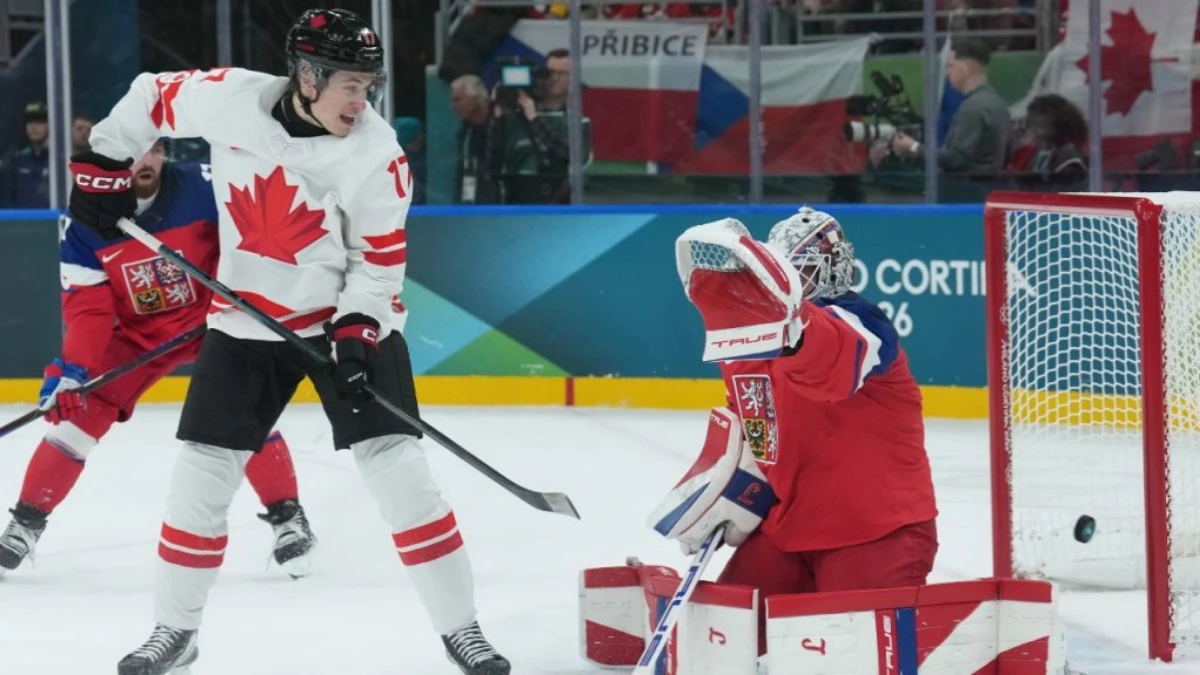
- Macklin Celebrini recorded one goal and one assist in Canada’s 5-1 victory over Switzerland at the Milano Cortina 2026 Winter Olympics.
- Skating alongside Nathan MacKinnon and Connor McDavid, Celebrini helped power Canada’s top line against a disciplined Swiss defense.
- The win strengthens Canada’s position in preliminary Group A and underscores the team’s blend of youth and elite NHL experience.
MILAN, Italy — Macklin Celebrini scored a goal and added an assist while skating alongside the NHL’s top two scorers, helping Canada defeat Switzerland 5-1 on Friday in a men’s preliminary round game at the Milano Cortina 2026 Winter Olympics.
The 19 year old center, who plays for the San Jose Sharks, connected early in the second period off a pass from Nathan MacKinnon to give Canada a 3-1 lead. The game was played at the Milano Santagiulia Ice Hockey Arena.Celebrini has now scored in consecutive games for Canada in the tournament.
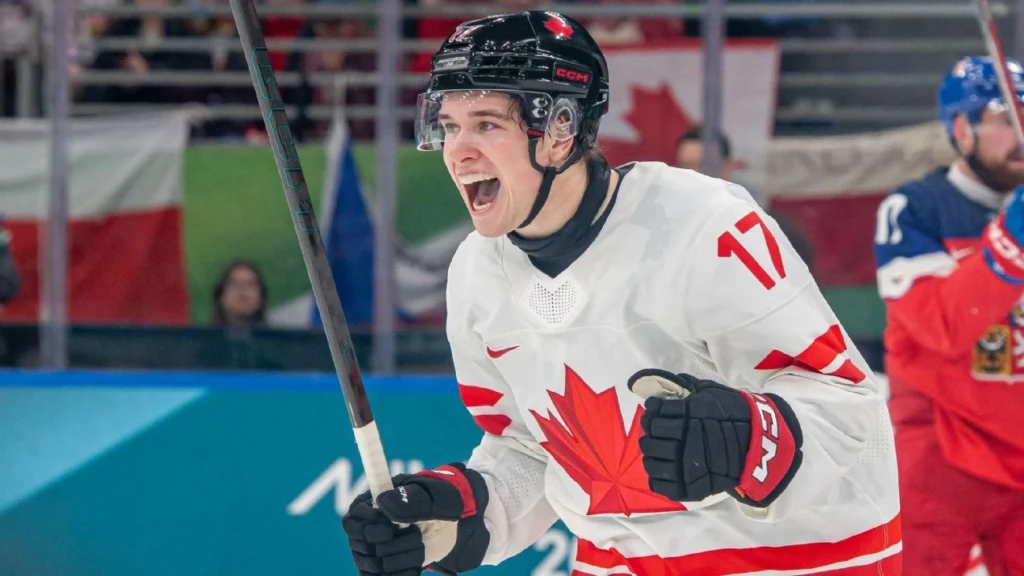
The performance marked another step in Celebrini’s rapid ascent on the international stage. Tasked with centering or complementing two of the NHL’s most productive forwards, the teenager showed composure and awareness beyond his years as Canada improved to 2-0 in group play.
Canada entered the tournament as a medal favorite, bolstered by the return of NHL players to Olympic competition.
Switzerland, anchored by Philipp Kurashev, sought to slow the tempo with structured defensive play, but Canada’s speed and transition game proved decisive.
The Milano Cortina 2026 Games mark the first Winter Olympics since 2014 to feature a full complement of NHL players, restoring a level of star power absent in 2018 and 2022.
Hockey Canada officials have emphasized the importance of integrating emerging players with established NHL veterans.
Celebrini, selected first overall in the 2024 NHL Draft, has been viewed as a cornerstone for Canada’s next generation.
His inclusion on a line with MacKinnon and McDavid reflects a strategic approach:
pairing elite playmakers with a developing center capable of finishing and facilitating.
Historically, Canada has relied on veteran heavy Olympic rosters.
The integration of teenagers into top line roles has been rare. According to Hockey Canada records, only a handful of players under age 20 have logged top-six minutes in Olympic competition since NHL participation began in 1998.
James Duthie, a senior broadcaster with TSN who is covering the tournament in Milan, said Canada’s coaching staff appears intent on accelerating Celebrini’s development through exposure to elite linemates.
“Playing with MacKinnon and McDavid forces quick reads and quick decisions,” Duthie said. “You either adapt to that pace or you struggle. Celebrini has adapted.”
Renée Hess, founder of the Black Girl Hockey Club and an analyst of international hockey development systems, said Canada’s approach reflects broader trends in global player development.
“You’re seeing national federations trust younger players earlier,” Hess said. “The gap between junior dominance and elite professional play has narrowed because of year round training and analytics driven development.”
Hess added that placing Celebrini with established NHL scorers signals confidence from Canada’s coaching staff and provides a controlled environment for growth.
Canadian head coach André Tourigny said after the game that Celebrini’s performance reflects preparation rather than circumstance.
“He competes every shift,” Tourigny said. “He reads the ice well and he is not intimidated by the moment.”
Swiss coach Patrick Fischer said his team struggled to contain Canada’s speed in transition.
“When you give space to players like that, they make you pay,” Fischer said. “Our structure was better in stretches, but against elite talent you must sustain it for sixty minutes.”
MacKinnon credited Celebrini’s positioning on the second period goal.
“He found open ice,” MacKinnon said. “That’s what good players do.”
Canada will face tougher defensive systems as group play continues, including matchups against European teams known for layered neutral zone coverage. Maintaining chemistry among star forwards while balancing ice time across four lines will be a priority for the coaching staff.
Tournament scheduling also presents challenges. With games compressed into a short window, recovery and lineup management will be critical.
Hockey Canada’s medical staff has emphasized monitoring player workloads, particularly for those logging significant minutes.
For Celebrini, sustained production could cement his role deeper into the tournament, particularly if Canada advances to the medal round.
Olympic competition provides limited margin for adjustment, making early contributions significant in shaping line combinations and special teams deployment.
Macklin Celebrini’s goal and assist in Canada’s 5-1 win over Switzerland highlighted the impact of pairing emerging talent with established NHL leaders.
As the Milano Cortina 2026 tournament progresses, Canada’s blend of youth and experience will continue to define its pursuit of Olympic gold.


