
KEY POINT
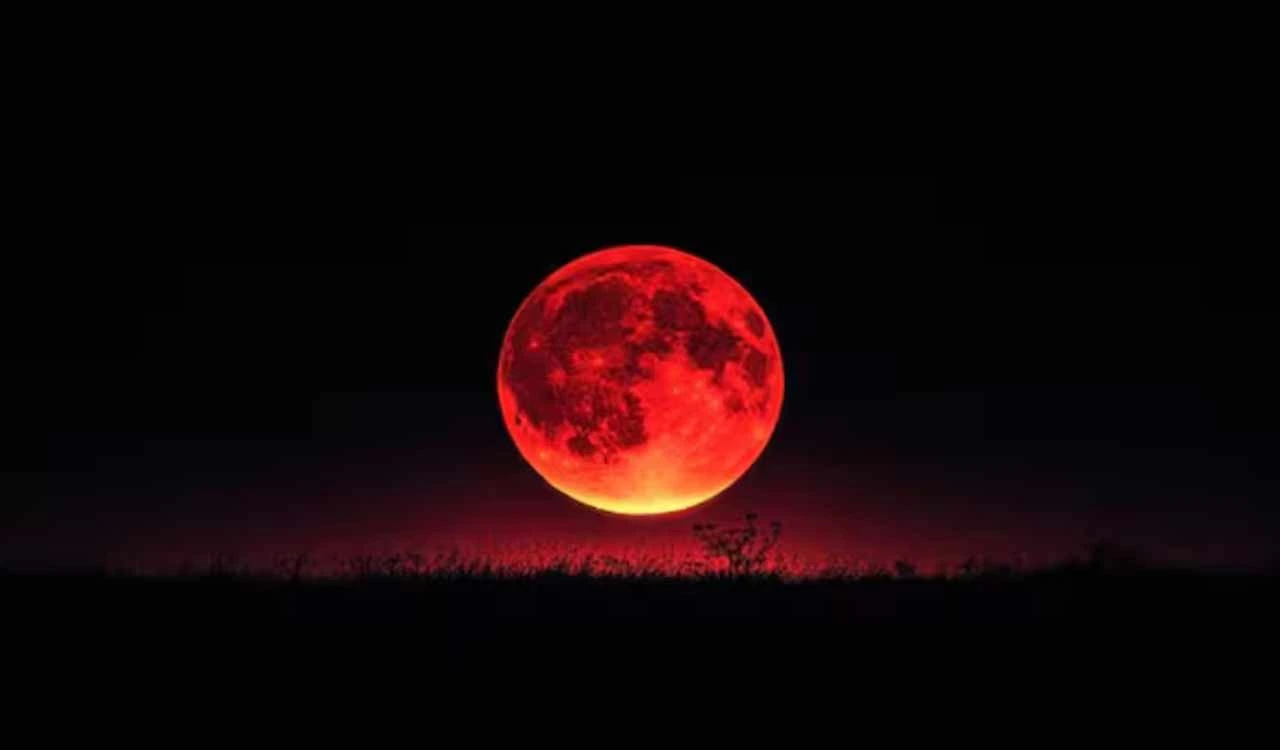
Visual spectacle: The Moon will glow red or orange as Earth’s atmosphere filters sunlight.
Global visibility: Observers in North America, parts of South America, East Asia, and the Pacific will see the eclipse.
Scientific insight: The color change demonstrates atmospheric light scattering and provides indirect data on Earth’s atmosphere.
March 3, 2026 — Sky watchers across parts of the globe will witness a spectacular astronomical event Tuesday as a total lunar eclipse turns the March full Moon into a vivid red orb.
The phenomenon, often referred to as a “blood moon,” occurs when Earth moves directly between the Sun and Moon, casting its shadow across the lunar surface.
The eclipse will begin at 3:44 a.m. Eastern Time, with totality when the Moon is entirely within Earth’s umbral shadow peaking at 4:50 a.m. ET. This will be the last total lunar eclipse visible from the United States until late 2028.
Total lunar eclipses are rare events when Earth blocks direct sunlight from reaching the Moon. During such eclipses, sunlight that passes through Earth’s atmosphere bends toward the Moon, with shorter blue wavelengths scattered and longer red and orange wavelengths reaching the lunar surface. The result is a reddish Moon visible across the night sky.
The March full Moon is known as the “Worm Moon,” a name rooted in northern hemisphere tradition, marking the time when earthworms begin to reappear as soils warm in early spring.
Lunar eclipses only happen during a full Moon. The March 3 eclipse is a prime example of celestial alignment, known as syzygy, where the Sun, Earth, and Moon fall nearly in a straight line.
Unlike solar eclipses, which are only visible in narrow geographic paths, lunar eclipses can be observed from anywhere on Earth where the Moon is above the horizon.
Earth’s atmosphere plays a critical role in coloring the Moon during totality. Particles, dust, and aerosols influence how much light is scattered, making the Moon appear brighter, darker, or more coppery depending on atmospheric conditions.
“Earth’s atmosphere acts as a natural filter during lunar eclipses, allowing only the redder wavelengths of sunlight to reach the Moon,” said Dr. Laura Esposito, planetary scientist at the University of Arizona Lunar and Planetary Laboratory. “This is why the Moon takes on a dramatic red hue rather than appearing gray or white.”
Dr. Mark Garcia, astrophysicist and former director of NASA’s Earth Science Division, added: “Volcanic eruptions or wildfires can intensify the red coloration, while clearer skies produce brighter copper tones. Observers are essentially seeing a visual representation of our atmosphere’s composition.”
Amateur astronomer Keiko Matsubara in Tokyo said she plans to guide her astronomy club through viewing: “Watching the Moon change color is an unforgettable experience, especially for young learners.”
In Sydney, stargazing instructor Luke Warren encouraged public observation: “No special equipment is needed. This is one of the few celestial events visible to the naked eye, offering both education and spectacle.”
After this eclipse, observers will have to wait until 2028 for the next total lunar eclipse visible from the United States. Meanwhile, astronomers can use the red coloration to study atmospheric clarity and light scattering, providing indirect measurements of environmental changes.
The total lunar eclipse of March 3, 2026 offers a rare and visually striking demonstration of Earth Moon Sun interactions.
The red Moon will not only be a highlight for stargazers but also a practical illustration of atmospheric optics in action, combining beauty and science in a single, awe-inspiring event.


