
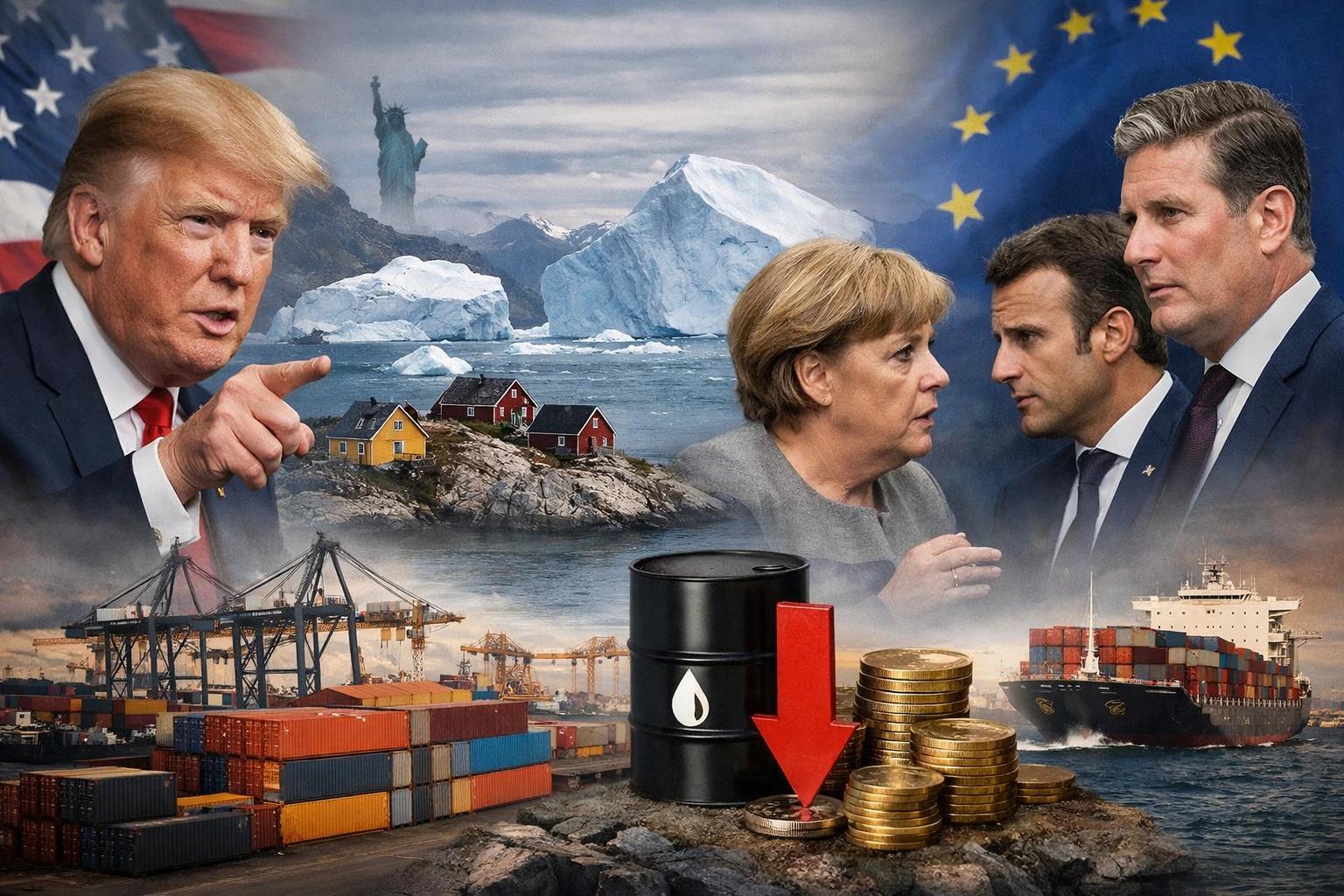
LONDON, Jan. 18, 2026 Global financial markets faced renewed volatility after U.S. President Donald Trump announced he would impose escalating tariffs on multiple European nations until the United States is allowed to purchase Greenland, an autonomous territory of Denmark. The move has intensified transatlantic tensions and raised concerns over trade, security, and diplomatic relations.
KEY POINT
- U.S. tariff plan: Trump will impose a 10 percent tariff on goods from Denmark, Norway, Sweden, France, Germany, the Netherlands, Finland, and Great Britain starting Feb. 1, rising to 25 percent on June 1 if no agreement on Greenland is reached.
- European reaction: Leaders of the eight countries and the European Union warned that the measure threatens NATO cohesion and undermines transatlantic relations.
- Market impact: Investors reacted to the announcement with heightened risk aversion, affecting currency, equity, and commodity markets.
The tariff announcement marks an unprecedented link between trade policy and territorial negotiations, as Trump has insisted on acquiring Greenland for its strategic Arctic position and rich mineral deposits.
European leaders have unanimously rejected the proposal, emphasizing Greenland’s sovereignty and democratic self-determination. Markets have responded with volatility, reflecting concern over rising geopolitical and economic risks.
Trump has long interest in Greenland, citing national security and resource advantages. Previous efforts to purchase the territory were rebuffed by Denmark and Greenland, which assert that the island is not for sale.
to Greenland under NATO operations, which the U.S. administration has criticized as a threat to American interests.
Economists and geopolitical analysts have raised alarms over the unusual strategy. Marie Dubois, senior economist at the Center for Transatlantic Relations, said, “Linking tariffs to territorial negotiations introduces unpredictable risk into global trade and could raise costs for businesses and consumers on both sides of the Atlantic.”
Jonathan Whittaker, a trade lawyer at GlobalTrade Counsel, noted, “Using tariffs to coerce sovereign decisions may violate World Trade Organization rules and could prompt legal challenges.”
European analysts warn that NATO cohesion is at stake.
Lars Petersen, a political risk consultant, said, “This challenges the fundamentals of allied cooperation. Collective European responses could redefine transatlantic diplomacy.”
Denmark’s Foreign Minister Lars Løkke Rasmussen stated, “Greenland’s future is a decision for Greenlanders and Denmark. Threats will not alter our democratic choices.”
British Prime Minister Keir Starmer called the U.S. tariffs “completely wrong,” highlighting that they undermine NATO’s collective security.
European Commission President Ursula von der Leyen and European Council President Antonio Costa said Europe will remain united and committed to upholding Greenland’s sovereignty.
The coming months will determine whether the EU pursues retaliatory measures, including potential counter-tariffs or WTO challenges.
Diplomatic channels may attempt to separate trade discussions from the Greenland dispute to protect ongoing US. EU negotiations.
Trump’s tariff announcement represents a rare convergence of trade policy and geopolitical maneuvering, challenging traditional frameworks of international cooperation.
The long-term implications for transatlantic relations, trade agreements, and security alliances will remain under close scrutiny.


