
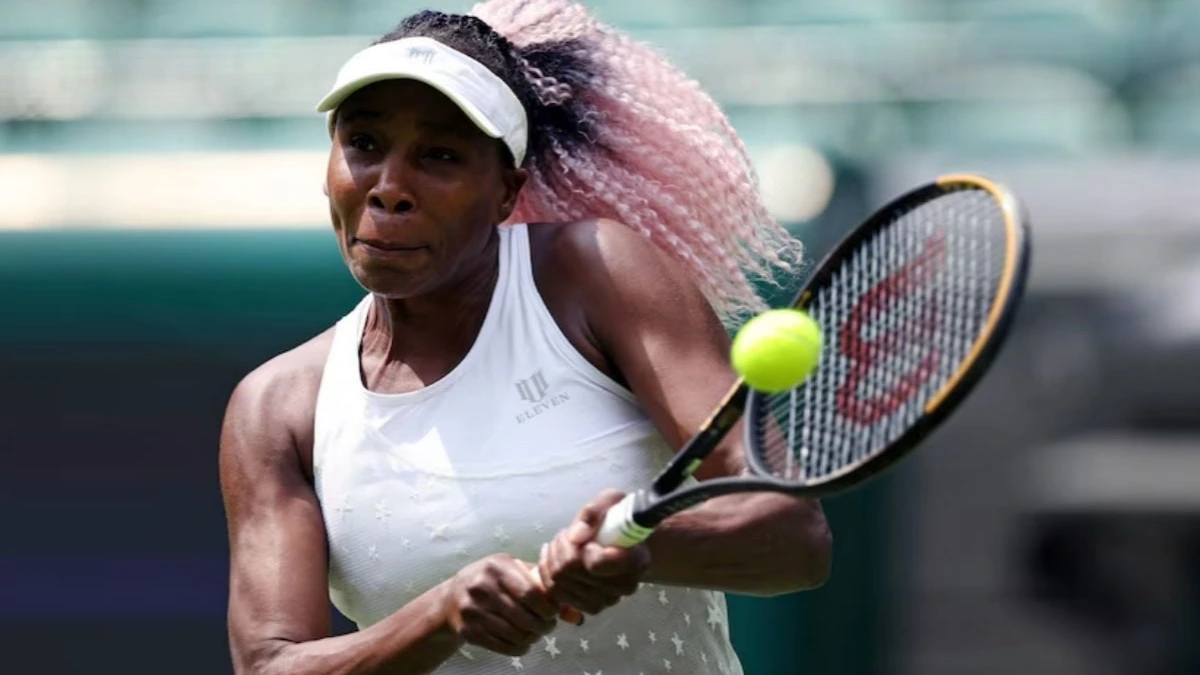
MELBOURNE, Australia Venus Williams made Australian Open history simply by stepping onto the court Sunday, becoming the oldest woman to compete in the tournament’s Open era. The milestone moment nearly turned into a victory before a late collapse, as Serbia’s Olga Danilovic rallied from deep in the third set to defeat the forty-five-year-old American 6-7 (5), 6-3, 6-4 in the first round at Melbourne Park.
KEY POINT
- Venus Williams Australian Open history was set with her appearance as the oldest female competitor in the Open era.
- Williams led 4-0 with two service breaks in the final set before losing six consecutive games.
- The match highlighted both the enduring competitiveness and physical limits of elite longevity in professional tennis.
The sight of Venus Williams walking into Rod Laver Arena carried significance beyond the scoreline. Her presence underscored a career that has spanned four decades, multiple generations of rivals and profound shifts in the women’s game.
While the result ended in disappointment, the match served as a rare, tangible example of sustained elite participation at an age long considered impossible in professional tennis.
Williams first competed at the Australian Open in nineteen ninety-eight, reaching the quarterfinals as a teenager. Since then, she has won seven Grand Slam singles titles, reshaped expectations around power and athleticism in women’s tennis and played a central role in the fight for equal prize money at the majors.
Her appearance this year marked the first time a forty-five-year-old woman has competed in the Australian Open singles draw in the Open era, which began in nineteen sixty-eight.
Previous longevity benchmarks were held by Martina Navratilova, who played her final Australian Open singles match at age forty-seven in doubles but exited singles competition earlier.
Williams entered the tournament using a protected ranking, a mechanism that allows injured players to return without relying on current ranking position. That pathway itself reflects structural changes within the sport designed to extend careers and protect veteran players from abrupt exits after injury layoffs.
Sports scientists say Williams’ continued presence on tour illustrates how advances in training, recovery and scheduling have altered the upper limits of athletic careers. Mark Kovacs, a tennis performance analyst who has worked with multiple Grand Slam champions, said longevity at this level was once “biologically unrealistic.”
“Modern load management, recovery protocols and data-driven scheduling allow players to compete longer, but competitive sharpness under pressure is still the hardest variable to maintain,” Kovacs said. “That final stretch of this match showed how narrow the margins are.”
From a competitive standpoint, the match followed a familiar pattern seen among veteran athletes. Williams relied on experience, serve placement and court positioning to control the opening set.
As rallies lengthened in the third set, Danilovic’s consistency and foot speed began to dictate play, forcing Williams into shorter points and riskier shot selection.
| Player | Year | Age | Grand Slam Singles Titles |
|---|---|---|---|
| Venus Williams | 2026 | Forty-five | Seven |
| Serena Williams | 2022 | Forty | Twenty-three |
| Martina Navratilova | 1994 | Thirty-seven | Eighteen |
| Chris Evert | 1989 | Thirty-four | Eighteen |
Data based on official tournament records and WTA statistics.
Danilovic credited composure rather than tactics for her comeback.
“I told myself to stay calm and play one point at a time,” Danilovic said. “Against someone like Venus, the match is never over until the last point.”
Tennis Australia tournament director Craig Tiley said Williams’ participation carried broader meaning for the event.
“Venus Williams Australian Open history is not just about age,” Tiley said. “It is about relevance, professionalism and what sustained excellence looks like in a global sport.”
Former world No. one Lindsay Davenport, now a television analyst, said the match illustrated why Williams remains a compelling competitor.
“She still reads the game as well as anyone,” Davenport said. “But when matches stretch late, especially in five-set equivalent intensity for women, the physical cost becomes decisive.”
Williams has not confirmed whether the match marked her final Australian Open appearance. She has previously said she evaluates her schedule year by year, factoring health and motivation rather than rankings.
Under current WTA regulations, she remains eligible to use protected ranking entries at selected tournaments if she chooses to continue.
The match also adds to ongoing discussions within tennis governance about veteran participation, wildcard allocation and how tournaments balance legacy appeal with competitive equity.
Venus Williams Australian Open history was secured before the first ball was struck, but the match itself reinforced the complexity of athletic longevity.
Her performance demonstrated that experience and skill can still bridge generational gaps, even as physical demands ultimately shape outcomes.
In a sport defined by relentless renewal, Williams’ appearance offered a rare continuity, linking tennis’ past, present and evolving future without sentimentality or spectacle.


