
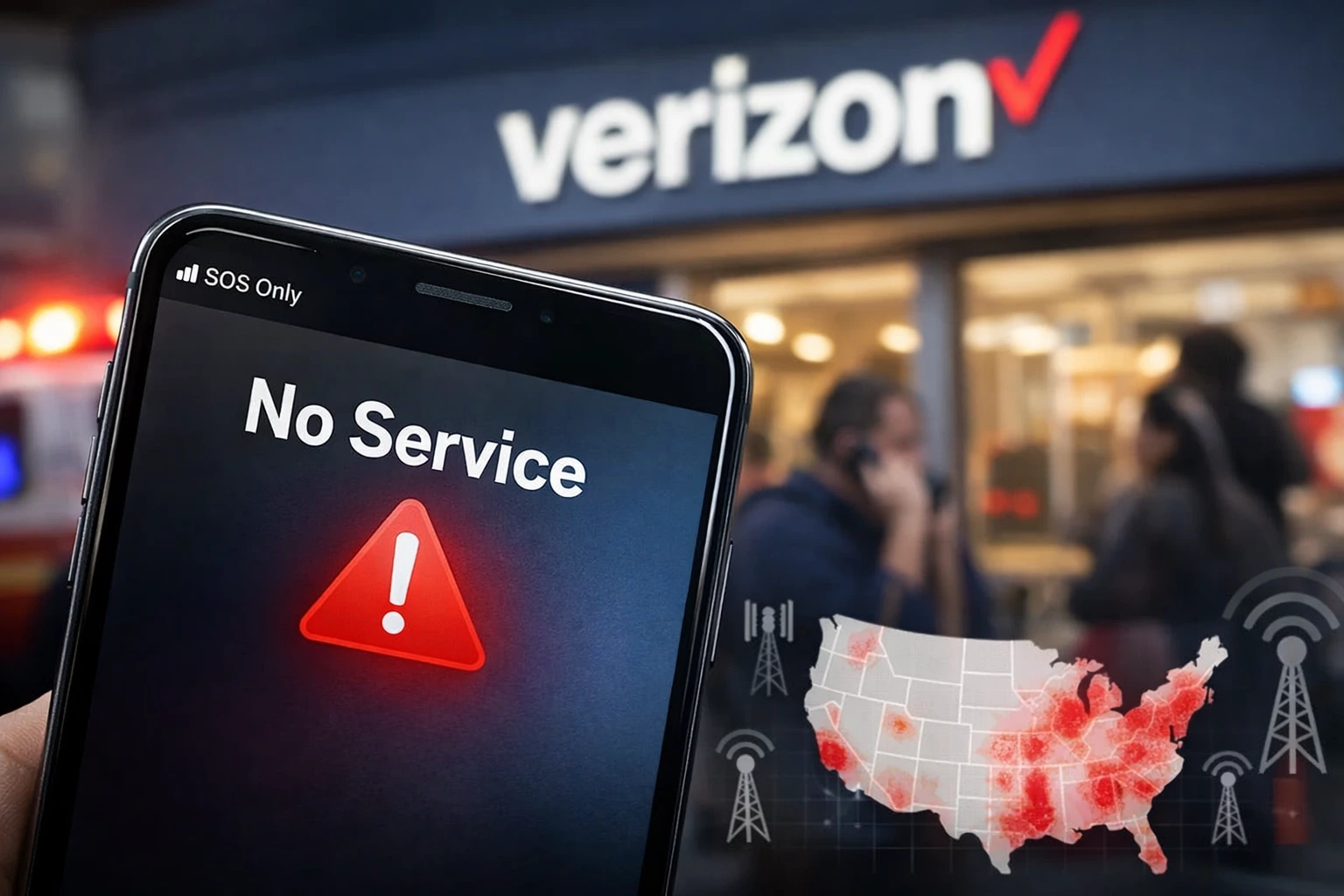
A nearly ten-hour Verizon nationwide outage on Jan. 14 disrupted mobile service for more than one and a half million customers across the United States, forcing phones into “SOS Only” mode and cutting off calls, text messages and mobile data, according to the company.
Verizon said service was fully restored late Wednesday night and pledged account credits for affected customers as it continues to review the cause of the failure
KEY POINT
The Verizon nationwide outage lasted almost ten hours and affected more than one and a half million users, including large parts of Florida.
Customers reported seeing “SOS Only” on devices, indicating loss of connection to Verizon’s core network.
Verizon said it will issue service credits and is conducting a technical review to prevent similar disruptions.
The Verizon nationwide outage quickly became one of the most disruptive U.S. telecom incidents of the year, highlighting the growing dependence on mobile networks for emergency communication, work and commerce.
While Verizon confirmed that service has been restored, the outage raised broader questions about network resilience, redundancy and consumer protections when large-scale failures occur.
Verizon is the largest wireless carrier in the United States, serving more than one hundred million connections across consumer, business and government accounts.
Large outages are rare but not unprecedented in the U.S. telecom sector, which relies on complex, software-driven networks that integrate radio towers, fiber backhaul and centralized core systems.
According to Verizon, customers across multiple states began reporting service loss early Wednesday morning.
Devices displayed “SOS Only,” a signal that the phone could connect to emergency networks but not to Verizon’s voice or data services.
Similar indicators appeared during past nationwide outages at other
, typically pointing to problems within the carrier’s core network rather than local tower damage.
The Federal Communications Commission requires major carriers to report significant outages that affect emergency services or a large number of users.
Verizon said it is cooperating with regulators and will submit a formal incident report detailing the scope and duration of the disruption.
Telecom engineers say the Verizon nationwide outage underscores how centralized network functions can become single points of failure if safeguards do not perform as intended.
“Modern mobile networks depend heavily on software-defined cores,” said Rebecca Miles, a U.S.-based telecommunications infrastructure analyst.
“When a core routing or authentication system fails, it can cascade rapidly, even if towers and radios are physically intact.”
Industry experts note that recent years have seen carriers accelerate software upgrades to support five G and advanced services. While these upgrades improve speed and capacity, they also increase system complexity.
“Resilience is no longer just about backup power or redundant towers,” said Carlos Mendoza, a former network reliability engineer for a major U.S. carrier. “It’s about how quickly systems can isolate faults and reroute traffic automaticall
| Metric | Verizon Outage Jan. 14 | Typical Major U.S. Carrier Outage |
|---|---|---|
| Duration | Nearly ten hours | Two to four hours |
| Estimated customers affected | More than 1.5 million | Hundreds of thousands |
| Primary impact | Calls, texts, mobile data | Usually localized service loss |
| Emergency access | SOS Only available | Varies by incident |
Verizon customers described widespread disruption to daily routines and business operations.
“I couldn’t make work calls or even text my family for hours,” said Miami resident Laura Chen, whose phone remained in SOS mode most of the day. “I rely on my phone for everything.”
Small businesses also reported losses. “We process orders and payments on mobile data when the Wi-Fi drops,” said Orlando shop owner Mark Alvarez. “Yesterday, everything stopped.”
Verizon spokesperson Kevin Whitmore said the company recognizes the inconvenience. “We understand the impact this outage had on our customers and apologize,” he said.
“Our teams restored service as quickly as possible and are taking steps to strengthen network safeguards.”
Verizon said it will automatically apply service credits to affected accounts, though the value and eligibility criteria have not yet been detailed.
The company also said it is conducting a full technical review, including failover performance and monitoring systems.
Regulators may examine whether additional reporting or resilience standards are needed as mobile networks become essential infrastructure.
Industry analysts expect carriers to face increased pressure to demonstrate redundancy not only for physical assets but also for software and cloud-based systems.
The Verizon nationwide outage of Jan. 14 served as a reminder of the critical role mobile networks play in modern life and the cascading effects when they fail.
While service has been restored and credits promised, the incident adds momentum to ongoing discussions about telecom reliability, transparency and accountability in an increasingly connected world.


