
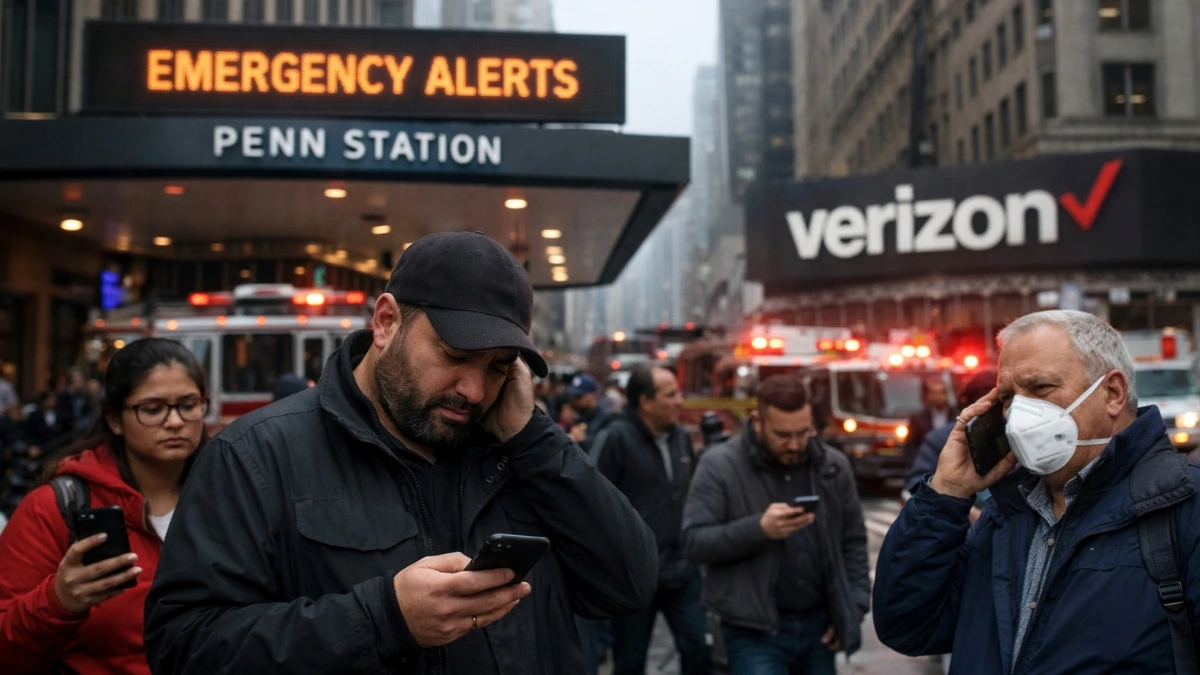
A widespread Verizon outage disrupted cellular data and voice services across parts of the United States on Wednesday, triggering emergency alerts and communication difficulties in Washington and New York City, according to the nation’s largest wireless carrier.
Verizon said engineers were working to identify and resolve the issue after customers reported sudden service losses affecting calls, text messages and mobile internet access.
KEY POINTS
- A Verizon outage affected voice and data services in multiple major U.S. cities, including Washington and New York City.
- Emergency alert systems and routine communications experienced delays or failures during the disruption.
- Verizon said engineers were actively working to restore service and assess the root cause of the outage.
The Verizon outage quickly drew national attention because of the carrier’s critical role in U.S. communications infrastructure, particularly in densely populated and government-heavy regions.
Verizon Wireless serves more than one hundred million subscribers nationwide, including federal agencies, emergency responders and major transit systems. Even short disruptions can ripple across public safety operations, financial markets and daily life.
Wednesday’s outage prompted concern after emergency alert notifications were issued in parts of the Washington metropolitan area and New York City, warning residents of potential communication disruptions.
While Verizon did not immediately provide a detailed cause, the company acknowledged that both cellular data and voice services were impacted for some customers.
Verizon operates one of the most extensive wireless networks in the world, relying on a complex mix of fiber backhaul, switching centers and cloud-based network management systems. Large-scale outages are relatively rare but not unprecedented.
Over the past decade, U.S. carriers have experienced service disruptions linked to software updates, fiber cuts, power failures and misconfigured routing systems.
In recent years, the expansion of fifth-generation, or 5G, networks has added further complexity.
While 5G promises faster speeds and lower latency, it also increases dependence on software-defined networking and centralized control systems. Industry analysts have warned that these architectures, while efficient, can amplify the impact of technical failures if safeguards fail.
The Verizon outage occurred amid heightened scrutiny of telecom resilience following a series of high-profile disruptions affecting airlines, financial trading platforms and cloud service providers over the past two years.
Telecommunications experts said the scale and geographic spread of the Verizon outage suggest a core network or signaling issue rather than localized tower failures.
“When you see simultaneous impacts in Washington and New York City, that points to a centralized element of the network,” said Harold Feld, a senior vice president at Public Knowledge,
A Washington-based consumer advocacy group focused on communications policy. “These systems are designed with redundancy, but redundancy does not eliminate risk.”
From an economic perspective, even brief service interruptions can carry significant costs. Mobile networks underpin payment systems, ride-hailing services, logistics tracking and remote work.
According to analysts at New Street Research, a nationwide wireless outage lasting several hours can translate into tens of millions of dollars in lost productivity.
The Verizon outage also raises policy questions. Federal regulators have emphasized the importance of network reliability, particularly for carriers that support emergency services. Verizon is a key provider of priority communications for first responders under federal contracts.
| Event | Year | Duration | Primary Cause | Impact Area |
|---|---|---|---|---|
| Verizon Nationwide Outage | 2020 | Several hours | Network routing issue | Multiple states |
| AT&T Wireless Disruption | 2023 | About ten hours | Software update failure | Nationwide |
| Verizon Outage | 2026 | Ongoing (Wednesday) | Under investigation | Major |
Verizon acknowledged the disruption in a brief statement.
“Our engineers are engaged and are working to identify and solve the issue quickly,” the company said.
In Washington, local officials said they were monitoring the situation closely.
A spokesperson for the District of Columbia Homeland Security and Emergency Management Agency said the agency was in contact with Verizon and federal partners to ensure continuity of emergency communications.
Some customers described widespread confusion. “Calls were dropping, and data just stopped working,” said Maria Lopez, a small business owner in Manhattan who relies on mobile payment systems. “For about an hour, we could not process card payments.”
Industry experts stressed the importance of transparency. “Customers and public agencies need timely, clear information during a Verizon outage,” said Nicole Saunders, chief executive of Spectrum Networks Group, a telecom consulting firm. “That helps mitigate panic and allows contingency plans to activate.”
Verizon said it would provide updates as engineers isolate the cause of the outage. Industry practice typically involves a post-incident review once service is restored, which may be shared with regulators if the disruption affected emergency services.
The Federal Communications Commission has authority to investigate major telecom outages, particularly those impacting public safety. While the agency has not announced formal action, similar incidents in the past have led to voluntary compliance plans and network resilience upgrades.
Telecom analysts expect carriers to continue investing heavily in redundancy, automated monitoring and rapid failover systems as networks become more software-driven.
The Verizon outage underscored the central role wireless networks play in modern society and the cascading effects when service is disrupted in major cities.
As Verizon works to restore full functionality and determine the cause, the incident adds to a growing record of large-scale technology disruptions that challenge assumptions about digital reliability.
For governments, businesses and consumers, the episode highlights the ongoing need for resilient communications infrastructure in an increasingly connected world.


