
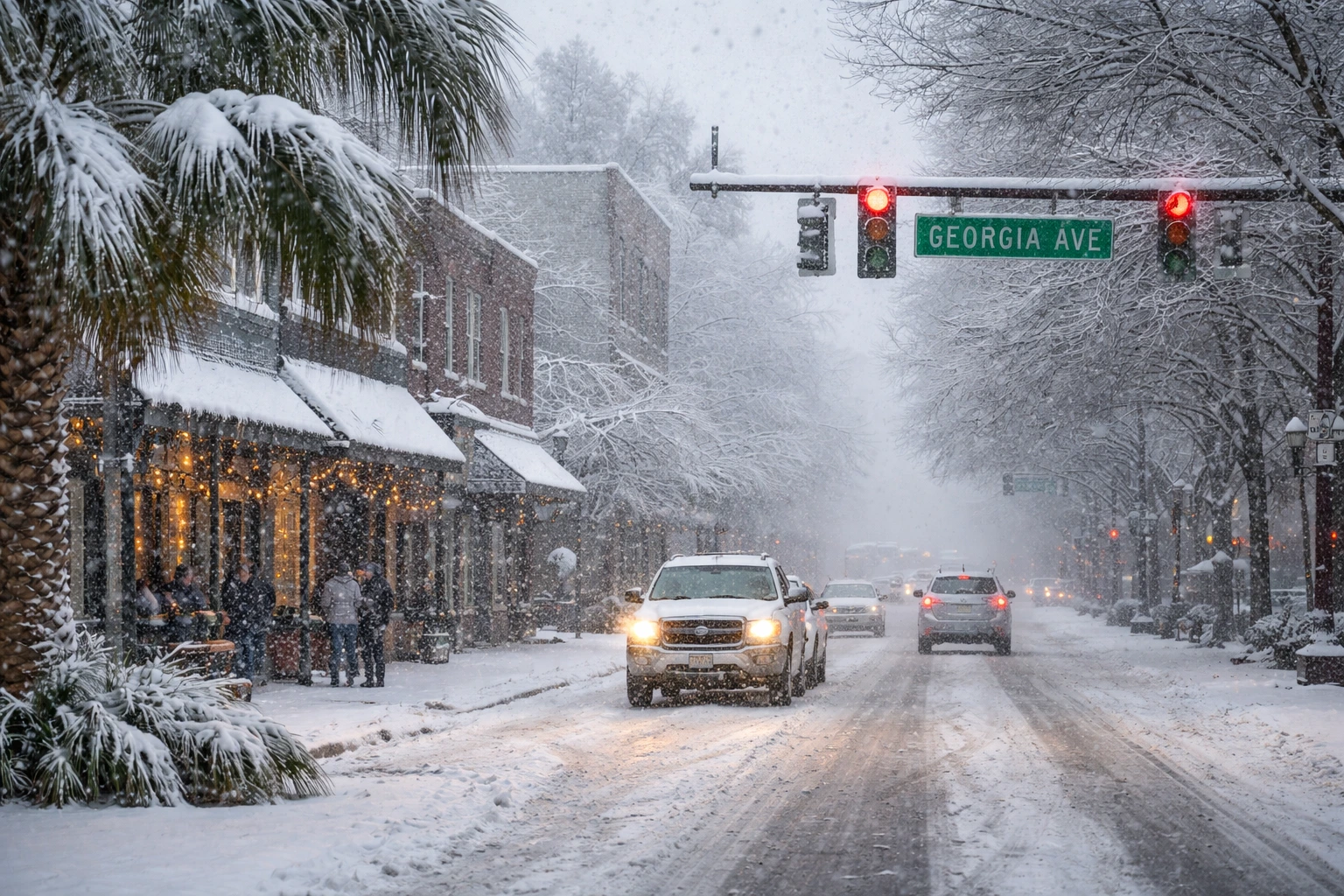
A powerful winter storm pushed unusually cold Arctic air deep into the southeastern United States early Sunday, delivering rare snow in the South to parts of Georgia, Alabama and even northern Florida, snarling travel, closing schools and prompting widespread warnings about icy roads and power disruptions, forecasters said
KEY POINT
- Rare snow in the South fell across Georgia, Alabama and the Florida Panhandle as Arctic air collided with Gulf moisture.
- Transportation agencies warned of hazardous travel as untreated roads iced over in regions unaccustomed to winter storms.
- The same system was forecast to spread snow into the Northeast, highlighting the storm’s broad national reach.
Snowfall in the Deep South is uncommon, but Sunday’s storm underscored how quickly weather patterns can shift when cold air plunges far below its usual boundary.
From Macon and Columbus in Georgia to coastal counties in Alabama and the Florida Panhandle, residents woke to snowflakes, sleet and rapidly deteriorating road conditions.
The rare snow in the South prompted emergency declarations in some areas and forced officials to balance public safety with limited winter-weather infrastructure.
According to the National Weather Service, the storm developed over the Gulf of Mexico before tracking eastward along the Atlantic Coast.
Moisture drawn north from the Gulf met anomalously cold Arctic air spilling south from Canada, creating conditions favorable for snow in regions that typically see winter precipitation as rain.
Historically, measurable snowfall in central and southern Georgia occurs only a handful of times per decade. Florida averages less than one inch of snow statewide in most winters, with many years recording none at all, according to federal climate data.
The appearance of rare snow in the South therefore carries outsized consequences, particularly for transportation systems, agriculture and emergency services that are not designed for freezing conditions.
Meteorologists said the storm reflects a broader pattern of increasingly volatile winter weather, even as long-term average temperatures trend upward.
“This is a classic setup where Arctic air pushes farther south than usual while Gulf moisture remains abundant,” said Rick Davis, a meteorologist with the National Weather Service in Atlanta. “When those two ingredients overlap, even briefly, you can get impactful snow in places that don’t see it often.”
Emergency management officials stressed that the danger often comes less from snowfall totals and more from ice. Bridges and overpasses freeze quickly, and many southern jurisdictions lack sufficient salt trucks or plows.
“Two inches of snow here can be more disruptive than six inches in northern states,” said Alabama Emergency Management Agency Director Brian Hastings, citing limited treatment capacity and driver unfamiliarity.
Economically, even short-lived winter storms can have ripple effects. Regional trucking routes were slowed, flights were delayed at smaller airports and farmers expressed concern about cold stress on winter crops and livestock.
In Macon, Georgia, resident Angela Brooks said the snowfall was beautiful but unsettling.
“We don’t have snow tires or plows like they do up north,” Brooks said. “It only takes a little ice for everything to shut down.”
Transportation officials echoed those concerns.
“Motorists should avoid travel if possible until temperatures rise,” said Georgia Department of Transportation spokesperson Natalie Dale. “Our crews are focused on major routes, but secondary roads may remain hazardous.”
In the Florida Panhandle, Escambia County officials warned residents to stay off bridges after early-morning reports of black ice.
“This is not typical winter weather for our area,” county administrator Wes Moreno said. “Even light snow can create dangerous conditions.”
Forecasters said the coastal storm system would continue moving northeast along the Atlantic, bringing snow to parts of the Mid-Atlantic and New England before reaching Atlantic Canada by late Sunday and Monday.
As the system departs the Southeast, temperatures are expected to rebound gradually, reducing ice risks by Monday afternoon.
However, officials cautioned that lingering cold overnight could refreeze melted snow. Power companies across Georgia and Alabama said they were monitoring isolated outages caused by ice-laden trees and lines.
The rare snow in the South served as a reminder of how vulnerable warm-weather regions can be to infrequent but disruptive winter events.
While snowfall totals remained modest by northern standards, the storm’s impact stretched from Florida to New England, underscoring the need for preparedness even in places where snow is seldom seen.


